From the Archives: ORT training was ‘key’ to surviving the Holocaust

This article was originally published by World ORT in August 2009.

On the eve of the Holocaust there were 37,000 Jews in the historic Lithuanian city of Kovno (Kaunas). By the end of the Shoah there were some 3,000 survivors, most of them in concentration camps in Germany.

Among them was Elly Gotz (pictured right) who had secured a ‘cushy’ job at Dachau thanks to training he had received at the ghetto’s ORT workshop.

The malnourished 16-year-old worked gruelling 12-hour shifts looking after a huge concrete mixing machine, but in southern Germany in winter, working under shelter meant the difference between life and death.

“My survival in Dachau relied to a large extent on my ORT training,” Mr Gotz, a past-president of Toronto Men’s ORT, said. “My cushy job was entirely due to being a trained, skilled metal worker – which I would not have been without ORT. If not for that I would have been working outside and my chances of survival would have been greatly reduced.”

It is an experience which has left him a passionate advocate of learning a trade.

“The pleasure of having a skill is greatly undervalued in today’s society,” he said. “But it has very important properties for a person’s psyche. Young people shouldn’t just go to university, they should learn a useful trade first.”

To emphasise his point he remembers after the war doing an ORT radio mechanics course at the Displaced Persons camp at Landsberg-Am-Lech in Germany – his second experience of ORT’s redemptive qualities. In particular he remembers a fellow student’s transformation in experiencing the satisfaction of building a radio from scratch.

“We knew little about his history but rumour had it that he had been through a particularly horrible set of experiences during the Holocaust,” Mr Gotz said. “He was dour, not friendly with anyone, although we tried to include him. If anyone touched his tools he reacted with fury. He never smiled.

“It so happened that his wireless receiver was the first in class to come on loud and clear. We all jumped up to congratulate him and for the first time we saw a broad smile come on his face. We were so pleased to see it! From that moment on he became part of our group, cooperative and friendly.

“That event made me realise that skill, and a person’s awareness that they have skill, is a great source of happiness in life. Knowing how to do something well has healing properties.

“ORT has, through the 130 years of its existence, created a happier people, given untold humans a solid, permanent base of joy in life. I know it did for me.”
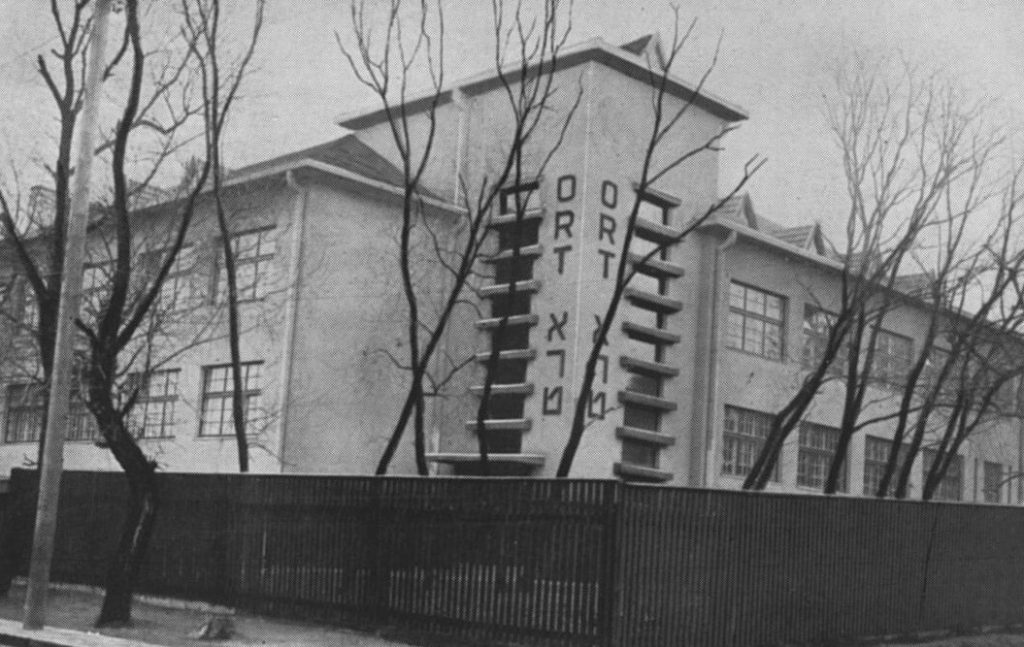
The ORT school in Kovno – image taken in around 1940

It was 65 years ago this summer that Mr Gotz was shipped out of the Kovno Ghetto with the 6,100 other Jews who had survived the privations and cold-blooded murder of the previous three years. The fact that he had survived thus far was itself due in large part to ORT.

The Altestenrat (Council of Elders), the group of prominent Jews which ran the ghetto’s internal affairs under German direction, had been permitted to establish a training school for children aged 12 to 15 to prepare them for the work they would be required to perform from the age of 16. Dr Jacob Oleiski, who had been the Director of ORT Kovno, became the director of the school and he used teachers from the previous ORT school as many of them were in the ghetto, Mr Gotz said.

“I joined the locksmith and metal work section and loved the experience. The acquiring of practical skills was complemented by the learning of theory and Jewish subjects and the result was a respite from the miserable reality of the ghetto.”
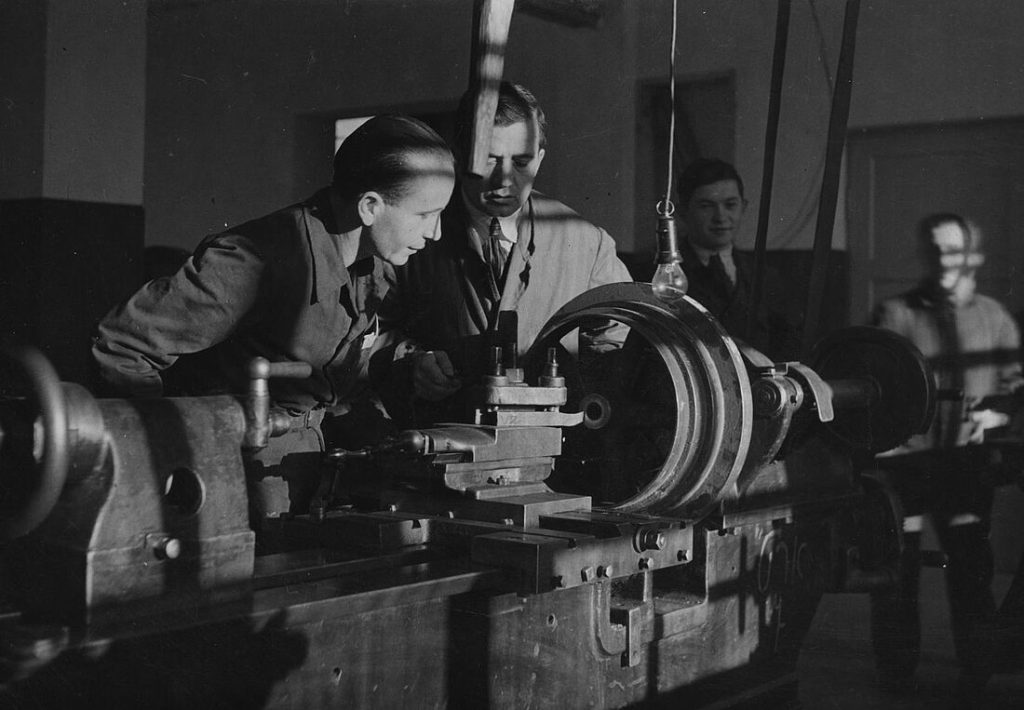
A student and teacher in an engineering workshop at ORT Kovno in 1937

Mr Gotz proved to be a good student, becoming particularly skilled at locksmithing, and, at the age of 15, was appointed a full instructor. It was at that time that he remembers a Mr Kadish coming into the workshop to take a photograph of him teaching younger boys.

“This guy came in, opened his leather jacket and brought out a camera. I was shocked because I knew that the Germans killed people for having a camera. He told us not to look at the camera so that if the photograph was found we could claim not to have known it was being taken,” he said.

The photographer was living up to his name by creating a pictorial memorial for a community which he expected would soon be extinguished. He developed the hundreds of pictures he took of ghetto life in the x-ray department of the German hospital where he worked and buried the negatives only to dig them up from the ghetto’s scorched remains after the war. The negatives were stored at a kibbutz in the Negev, Mr Gotz said.

“But during the 1967 war, the kibbutz was hit by Egyptian fire and many of the negatives were lost but not my photo, which I saw for the first time while watching a slide show about the Kovno Ghetto at the Holocaust Museum in Washington in 1994!”

Mr Gotz worked in the Fachschule until the ghetto was liquidated and the remaining people were sent to Germany in cattle cars – the women to Stutthof and the men to Dachau concentration camp. At Dachau, Mr Gotz managed to bring his father into his workshop as an assistant, thereby helping him to survive.

“We were liberated on April 29, 1945. We found out that my mother had survived Stutthof concentration camp and we were a complete family again. I was an only child,” he said.

It was in December 1945 with more than 95 per cent of Lithuania’s pre-war Jewish population of 235,000 dead that Mr Gotz enrolled in the ORT radio mechanics course at the DP camp.

He received an ORT diploma after 12 months of energetic study, during which time he took private lessons in maths and studied physics and chemistry on his own. He passed a tough entrance exam to Munich’s Engineering University to study electrical engineering but he and his parents decided to leave Germany for Norway.

“In Oslo I went out looking for a job and soon found one as a radio mechanic,” he recalled. “I was quite unsure how I would do but I discovered that ORT had trained me well.”

Before long, the family joined relatives in southern Africa and, having learned English, he successfully negotiated the final year of high school before studying electrical engineering and electronics at the University of Johannesburg.

In 1964, with his wife Esme and their three children, Mr Gotz moved to Canada where he has lived ever since.

“For a number of years I was President of Toronto Men’s ORT, while my wife was President of Women’s ORT,” he said. “I have told my story at many ORT membership meetings and fundraising events. I have done my best to repay ORT for the great good it has done me.”


The main image is from Mr Gotz’s website which you can visit here.

You can find out more about ORT’s history in Lithuania in the World ORT Archive.
From the Archives: Albert Einstein comes to dinner

This article was written using material from the World ORT Archive. The site provides users with access to thousands of images, documents and other artefacts, giving an insight into ORTs rich past worldwide.

Did you know that Albert Einstein was guest speaker at an ORT dinner?

In 1930 British ORT held a dinner at the Savoy Hotel in London, at which Einstein spoke in the presence of George Bernard Shaw, H. G. Wells, Lord Rothschild and Chief Rabbi Joseph Hertz.

Shaw first gave a  speech in honour of Einstein, who then responded, saying: “It is no easy task for me to overcome my inclination to a life of quiet contemplation. Nevertheless, to the cry of ORT… I have been unable to tum a deaf ear. For it is at the same time to the cry of our heavily burdened people that I respond.”


You can watch a video of the event on the World ORT Archive.

New ORT Archive Offers Access to Trove of Historical Documents and Images

World ORT has launched a digital archive which aims to preserve historical records of the organization’s activities and to place them in the context of contemporary Jewish history.

The new World ORT Archive site provides users with access to thousands of images, documents and other artefacts, giving an insight into ORT’s rich past worldwide. There are also dozens of highlights from the organization’s film collection, and the opportunity to search the archive for the most relevant information about a place or time in our network’s 141-year history.

The creation of the site has been made possible by the generous support of the Rothschild Foundation Hanadiv Europe, which first backed the project in 2014.

Currently the site holds around 60 percent of the total historical archive material held by World ORT about the organization since its creation in St Petersburg, Russia, in 1880.

It is hoped the digital archive will make the material more accessible to academics and educators, with opportunities for its use across the more than 30 countries in ORT’s network today.

The thousands of digitized images form a rare and unique collection – covering ORT’s involvement in Jewish working life, education and vocational training. In many cases, these photographs are the only remaining record of communities, events and locations in Jewish history.

Many of the documents relate to ORT’s organizational background, including the World ORT Union’s governing bodies, minutes of their meetings, fundraising logs and other records.

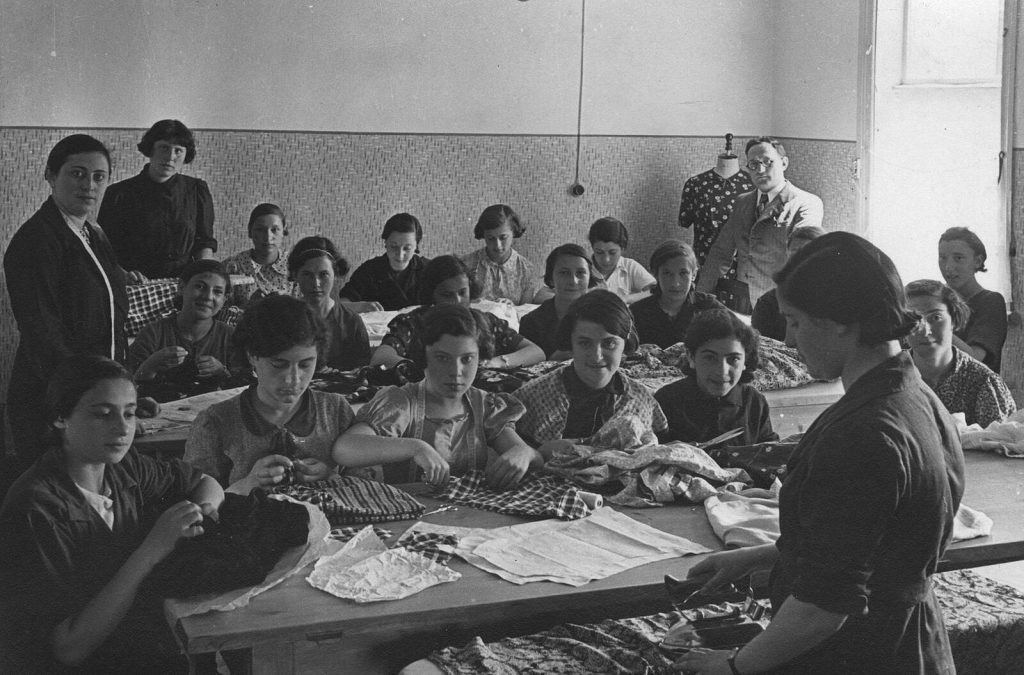
Students at a tailoring workshop in Šiauliai in Lithuania in 1939

Rachel Bracha, World ORT Archive Co-ordinator, said: “These documents provide a valuable insight into the organization’s activities and the communities which it served.

“ORT’s work over the past 141 years has been carried out against the backdrop of contemporary Jewish history. The archives include documents, reports, correspondence, films and photographs that provide a valuable insight into so much of our organization’s history, and indeed the history of the Jewish people.”

Dan Green, World ORT Director General and CEO, added: “We know the value people around the world place in being able to access records and information relating to the history of their families, schools and communities.

“We are regularly contacted by alumni, their children and grandchildren who want to know more about the places they grew up in and were educated in. With access to the new digital archive site, I am confident thousands of people around the world will be able to research this history themselves – whether for educational purposes, completing historical family records, or for helping new generations learn about their roots.”

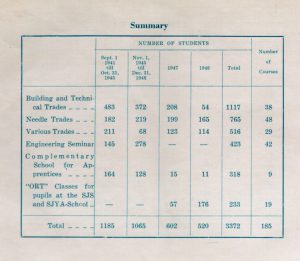
A 1940s document from the archive reveals statistics from ORT Shanghai, in China

Videos on the site feature activities in Jewish communities that have since disappeared from the map, especially in north Africa and parts of the Middle East such as Iran. They give a unique insight into the history of education and learning for Jews in those parts of the world.

It is hoped that further development of the site will make it possible to dig deeper into the stories of individuals who have lived and learnt at ORT schools.

If you have archive material including papers, documents, photographs of former staff or students that could be included in the archive – or information relating to ORT’s history in Canada, Latin America or our brief post-war program in Czechoslovakia, please contact us by emailing: [email protected]

(Image top right shows students at ORT Buenos Aires in Argentina in the 1940s)

What is World ORT

ORT is one of the largest non-governmental training organisations in the world. It is registered as an NGO with the United Nations. ORT is a worldwide Jewish charity that assists disadvantaged individuals and communities to become self-sufficient. ORT educates and trains people in skills that will provide them with sustainable employment in todays and tomorrows marketplace. … and welcome to ORTnet – the communications network of World ORT. ORTnet links World ORT’s National Organisations and supporters, ORT schools, Centres, and training programmes to provide a global focus for information and resources. What ORT does ORTs mission is educating for life. As one of the largest non-governmental education and training organisations in the world, ORT teaches and trains over 250,000 students annually in more than fifty countries. The programmes are geared to the demands of countries and to the demands of the workplace now and in the future. ORT leads the field in technological and vocational training in the developing world.ORT provides skills-training and self-help projects for some of the worlds most impoverished communities, using funds from development agencies and national governments to put people on the path to economic independence. ORT uses the most up-to-date teaching methods and equipment to train people for the careers that will make them independent, contributing members of their own society. At the cutting edge of modern technology, ORT continues to update and develop new programmes for its international student body. Through its own global distance education service, ORTnet accessible through the Internet ORTs educational programmes reach isolated communities and individuals worldwide.

What are International Missions

When World ORT members and supporters are asked what encourages them to increase their involvement with ORT, the most common response given is, ‘visiting the schools and actually meeting the students’ . That is why World ORT holds many exciting missions to numerous locations to see ORT programmes and students in action. World ORT missions show donors how their valued contribution has been spent, by visiting the wide range of educational projects ORT provides to Jewish communities around the world. If you would like to see how your contributions are used and visit new and exciting destinations, read on and contact us for further information or view the Diary for upcoming Mission dates. Not only do mission participants get to see how their contribution is being put to good use, but they also have the opportunity to visit destinations they wouldn’t normally venture to on their own. For example, Missions to countries in the CIS give participants the opportunity to see burgeoning Jewish communities, while giving delegates a chance to reconnect to their own Jewish heritage. Last year World ORT lead missions to Cuba, Belarus, France, Ukraine and Moldova to mention but a few. This year we have planned missions to Israel, Argentina, Uruguay, Bulgaria, Lithuania, Ukraine and Kiev. As a World ORT mission delegate, you will have an exciting, spiritual, and historical journey to places you have only dreamed of visiting whilst seeing the wonderful work that ORT is doing in these countries. You can also contact ‘The Missions Co-ordinator’ at the International Liaison Department of World ORT for information on any future missions. or Click here to contact us by email now, or send an email to [email protected]

Western Europe Review

For further information on ORT’s activities in Western Europe, notably the UK, France, Italy, the Netherlands and Switzerland, please read the full article. Jump to articles on UNITED KINGDOM | FRANCE | ITALY | SWITZERLAND BRITISH ORT British ORTs main campaign focus is to support World ORT activitiesworldwide. Support from UK-based donors has also been directedto specific projects in Ukraine, Israel, Argentina, Latvia and Russia inparticular the ORT Alef school in Zaporojie, Ukraine, the ORT Kazanschool in Tatarstan, and ORT Netanya Yad Lvovich, Israel. British ORTcontinues to build on its strong foundations. Ivor Levene, OBE has beenappointed Executive Director succeeding Rhonda Marcus, who hasjoined the Management Committee. Michael Naughton (left) with celebrated British actor Warren Mitchell, and British ORT Chairman Alan Goldman. Top calibre speakers addressed British ORT events. Sir Terry Leahy, ChiefExecutive of Tesco plc, the UKs leading supermarket chain, spoke to arecord breaking 400-strong audience at the Annual Business Breakfast.The Patrons Lunch was hosted by The Lord Rothschild OM, GBE, and theGala Dinner, which honoured Michael Naughton, whose support spansfive decades, was seen as one of the most successful and enjoyable in British ORTs history. Friends of ORT, co-chaired by Roslyn Morris andSusan Roffman, enjoyed a full programme through the year highlightedby the Annual Spring Luncheon with Oscar-nominated actor Tom Contithe main attraction. Young ORT worked closely with World ORTsInternational Next Generation initiative to develop its leadership, sowingthe seeds for the organisations future growth. FRANCE ORT France, founded in 1921, provides schooling and vocational adulteducation at seven schools and centres located in Paris, Strasbourg,Lyons, Toulouse and Marseilles. During 20042005, ORT France trainedand educated more than 6,700 students, including more than 4,000 adults.After six years of large scale renovation and rebuilding, the rejuvenatedORT school in the Paris suburb of Montreuil sous Bois was inauguratedand renamed the Daniel Mayer ORT High School. The outer walls were retained and the inside completely rebuilt in five stages. The renovationshave added 500 square metres of floor space (providing room for 800students and 100 trainees) and greatly improved the ergonomics of theenlarged classrooms. Students and teachers also benefit from newequipment, enhanced security and modern dining facilities. Electronics lesson, ORT Montreuil, France. Construction of the third floor at the ORT high school in Lyons has beencompleted, creating an additional 800 square metres for extraclassrooms.ORT France is working on the renovation of its schools in Toulouse andthe Paris suburb of Choisy-le-Roi, where prefabs are replacing theworkshops and classrooms. These works are expected to be completedby the end of 2006. In Strasbourg, the BTS doptique (Opticians Technical Diploma) sectionhas recorded its fourth successful year. The school attracts Jewish studentsfrom across France, not only because of its high standards but because ofits boarding facilities and kosher catering. The development of thisspecialisation will result in the creation of a professional degree in opticalstudies, in partnership with the University of Strasbourg, in 2006. At the initiative of the World ORT Representative in France, Guy Seniak,ORT France is updating Jewish teaching by creating a history and Jewishculture book financed by the Foundation for the Memory of the Shoah.In Paris, ORT France provides courses adapted to the specificrequests of companies wanting to retrain and upgrade new employees in the fields of ICT and foreign languages. In addition, inanswer to a call for tender from the European Commission, the newtechnology department takes part in a research and developmentprogramme for the implementation of new technologies in the fieldsof teaching and training. In September 2005, ORT France started training sessions in Morocco onbehalf of GFI Informatique, a major European provider of consultancyand ICT services to big business. In 2006, ORT France plans to start anew project with Le Bureau du Shabbat to set up IT training sessions tohelp some 100 unemployed Sabbath observant Jewish women competein the job market. ITALY World ORT is increasing its support for the Jewish communitys highschools in Rome and Milan. At the ORT Renzo Levi High School in Rome, enrolments continue toincrease 61 entered the 9th grade in the 20042005 academic year,a 42 percent increase on the previous year. The total number of studentsin grades 613 is now 191, almost double that seen when the schoolmoved to its new premises in the Ghetto, near the citys main synagogue,in 2003. To maintain manageable class sizes, refurbishments are due tobe completed early in 2006 that will see each grade divided into parallelclasses. Further such work will be undertaken if enrolment continues itsupward trend. This increasing popularity is a result of generally increased educationalstandards at the school, the addition of languages, social sciences andtechnological studies to the original scientific focus, and parents desire toplace their children in a safe, Jewish environment.As part of its constant effort to increase standards, ORT Renzo Levi HighSchool installed a 15-terminal computer laboratory in 2005; a newscience laboratory is due to be installed in 2006. The school in Milan has 545 students. Its popularity with thelocal Jewish community has increased thanks to the improvementsit has made in its Jewish education provision. Also, IT educationhas improved with the opening of two new computerlaboratories. For the first time, a group of its students is due tojoin hundreds of other ORT students on March of the Living, (theHolocaust education programme) in Poland in 2006. SWITZERLAND ORT educational operations in Switzerland ceased in 1992 and thecountry now hosts World ORTs legal headquarters (in Geneva)and an increasingly influential fundraising organisation consisting of fourcommittees: Geneva, Basel, Berne and Zurich. ORT Switzerland (Geneva) annual Gala Dinner. Among the major events of 2005 was the ORT Switzerland (Geneva)annual Gala Dinner which also commemorated World ORTs 125thanniversary. This event, In November, raised funds for ORT’s Schools Plus Programme in Israel, which provides extra support for outstandingstudents from families in distress and from socio-economically deprivedbackgrounds. The evening featured a performance by the internationallyrenowned Bejart Ballet Lausanne as well as a dinner for 400 at theGeneva landmark Batiment des Forces Motrice. The success of this eventhas raised ORT Switzerlands profile throughout the wider community.The ORT Switzerland international Jacqueline Maus Bridge Tournament,a regular major fundraising event, was held in November. The leadership of ORT Switzerland is anticipating some changes during2006. The President, Robert Equey, retains his position but the Director,Catherine Gentilini, is due to be succeeded by her daughter, VanessaCholat. The ORT Zurich annual event in September 2005 included the openingof an exhibition of paintings by an ORT Argentina graduate who nowlives in Switzerland.ORT Basel raised significant funds towards ORT programmes in Israel.

SASA Setton Kav Or lights up children’s time in hospital

It is the middle of a particularly hot, dry summer in Israel; not the time one would think the people there are in need of more sunshine. But for children in hospital it can be as gloomy as an English winter.

But World ORT’s SASA Setton Kav Or programme is lightening up the experience for thousands of kids with distance learning technology bringing fun-filled learning for classes at the schools at each of Israel’s 27 public hospitals as well as one-to-one tuition for long-term patients.

“It’s like a ray of sunshine in the hospital,”? said SASA Setton Kav Or Distance Learning Coordinator Tami Horovitz. “The children love it and the teachers are so happy that there’s someone else in the classroom with them.”?

Over the past eight months World ORT “モ in cooperation with Israel’s Ministries of Education, Health and Welfare, and the Prime Minister’s Office and thanks to a major donation from the Swiss-based SASA Setton Foundation “モ has invested significantly in revitalising the Kav Or (Ray of Light) nationwide hospital education network, installing wireless Internet connections, providing Interactive Whiteboards, desktop and laptop computers, robotics kits, training for teachers and volunteers, and revamping the SASA Setton Kav Or website. But one of the most significant improvements brought in by World ORT’s programmatic arm in Israel, Kadima Mada, since it joined forces with SASA Setton Kav Or late last year is the huge increase in distance learning provision.

Less than a year ago, funding issues meant that SASA Setton Kav Or was unable to provide the regular distance learning it wanted to. Now, two hours of classes on a wide variety of subjects are channelled into the hospitals via the Internet every day “モ exploring topics such as pirates and dinosaurs to practising English-language skills and challenging older children with presentations on ecology and biology. Lessons are provided in both Hebrew and Arabic to serve children throughout the country.

Each participating child has his own laptop, headset and microphone; the computer screen is filled with images and text which complement what the teacher is saying.

“Our goal is to use technology to reduce the educational gap experienced by children who miss school because of hospital treatment,”? said Avi Ganon, who is managing the SASA Setton Kav Or project. “We are close to ending the first stage, which is giving the necessary equipment and teacher training to all the hospitals in order to create one high standard and so allow us to provide a unified educational programme. Stage two will see us building on that with more advanced equipment and programmes, including science labs, and providing additional resources for isolated children in oncology wards and psychiatric hospitals.”?

The classes are ideal for most of the children who spend only a few days in hospital, but for the few who spend weeks or even months undergoing treatment it is the one-to-one private tuition which has a potentially life-changing effect.

SASA Setton Kav Or staff are particularly proud of Michael, who, thanks to the private tuition he received during four months at the Beit Levinstein Rehabilitation Hospital in Ra’anana where he was undergoing intensive treatment for cerebral palsy.

“He is in a wheelchair, can’t talk clearly and can’t write but he can type slowly so can use the laptop provided by us,”? Ms Horovitz said. “He was determined to pass the Bagrut [high school matriculation] history exam so we provided him with a lesson every day which he taped so he could listen to it over and over again. His teacher from the hospital school, Anat Elkalai, stayed with him during the distance learning lessons and typed for him to make the best use of the time available.”?

Despite being a year behind in his schooling, the individualised programme built around his needs allowed Michael to catch up. Not only did he manage to pass the exam, he scored an outstanding 90 per cent.

“We were all delighted because he’s such a special, determined young man,”? Ms Horovitz said. “The distance learning was essential because it gave him access to teachers who were qualified to teach at Bagrut level.”?

In a letter of thanks to the SASA Setton Foundation Michael said he was happy and proud of his exam score.

“I am so grateful for the chance to take the exam and to feel like any other student in class even though I was in hospital for a long, difficult period,”? he wrote.

Such personal tuition also proved highly successful for Itamar who, at 15, is two years younger than Michael. A keen sportsman, Itamar was struck down by a rare disease which left him unable to walk. Fortunately, he has been able to regain use of his limbs but the treatment, also at Beit Levinstein, took six months.

“We helped him in history, Bible, maths and Hebrew and he did so well that when he went home his parents continued the tuition at their own expense so he was able to catch up very quickly with his schoolwork and pass his exams,”? Ms Horovitz said.

While he was in hospital SASA Setton Kav Or also provided him with a digital camera. The control Itamar enjoyed in taking pictures, making movies and editing them proved invaluable in boosting his morale and motivation at a time when everything he did was dictated by his illness.

“Currently only two or three hospitalised students a week in the whole country need such personal tuition,”? Ms Horovitz said. “But we are committed to, and capable of, providing one-to-one distance learning for many more children should it ever be necessary. Not only that, we are due to double the number of hours we provide for classes so that the hospital schools can extend into the afternoons.”?

To make it even more appealing for children there are plans to invite celebrities to appear in distance learning classes from time to time. Doctors, too, can participate and answer children’s questions about illnesses and treatments in a bid to reduce any anxiety they may have.

The World ORT programme also works in full cooperation with SASA Setton Kav Or’s 300-plus volunteer supporters.

These volunteers continue to play a vital role. Among them are two Arab and one Jewish biotechnology undergraduates who are each receiving a joint Kadima Mada-Perach scholarship, funded mainly by ORT America, to cover their tuition fees; in return they have been trained to teach science to the hospitalised children through the distance learning programme.

“They are young so they can talk to the kids in a special way that really engages them,”? Ms Horovitz said.

Other undergraduates on the scholarship programme are volunteering for SASA Setton Kav Or at hospitals in Nahariya and Tsfat. And teachers at the hospital schools receive invaluable support from religious girls who work full days there as part of their national service, some of whom are organised by SASA Setton Kav Or and funded by the SASA Setton Foundation.

She concluded: “SASA Setton Kav Or is a great programme and feel honoured to be a part of it. And I know that the hospitals’ teaching staff are having a wonderful time and learning so much. What they do and what SASA Setton Kav Or provides complement each other nicely.”?

Kadima Mada Executive Director Rony Kalinsky knows from personal experience the importance of providing these young patients with educational opportunities.

“I spent nearly nine months in hospital when I was 17 and took all my Bagrut exams there,”? Mr Kalinsky said. “I know just how challenging it is to learn while ill but I also know that having the opportunity to keep up with schoolwork while in hospital helps to maintain morale and speeds your recovery.”?

Join ORT Worldwide

Become part of World ORT’s amazing circle of supporters – contact your nearest office now. The rewards are enormous. Join us now. See our Links section above for individual websites.. FUNDRAISING COUNTRIES Through our Fundraising offices you will be able to meet like-minded people, attend events and raise money for ORT campaigns. UNITED KINGDOM British ORT Tel: +44 20 7446 8520 Email: [email protected] UNITED STATES ORT America Tel: +1 212 505 7700 Email: [email protected] CANADA ORT Canada Tel: +1 416 787 0339 Email: [email protected] BELGUIM ORT Belguim Tel: +32 2 375 2100 Email: [email protected] DENMARK ORT Denmark Tel: +45 33 18 18 00 Email: [email protected] FINLAND ORT Finland Tel: +35 850 3076425 Email: [email protected] GERMANY ORT Germany Tel: +49 69 94 34 34 34 Email: [email protected] NETHERLANDS ORT Netherlands Tel: +31 71 561 3193 Email: [email protected] SWEDEN ORT Sweden Tel: +46 8 555 110 30 Email: [email protected] SWITZERLAND ORT Switzerland Tel: +41 22 919 4234 Email: [email protected] OPERATIONAL COUNTRIES Operational countries run our schools, colleges and programmes. If you would like to become involved in our operations, please contact an office below. ADMINISTRATIVE HEADQUARTERS World ORT Tel: +44 20 7446 8500 Email: [email protected] ARGENTINA ORT Argentina Tel: +54 11 4789 6502 Email: [email protected] BELARUS ORT Belarus Tel: +3 751 72210602 BOLIVIA Tel: +5 912 483584 Email: [email protected] BOSNIA c/o ORT International Cooperation Tel: +1 202 2932560 Email: [email protected] BULGARIA Tel: +359 2 931 6093 Email: [email protected] CHILE ORT Chile Tel: +56 2 235 7585 Email: [email protected] CUBA ORT Cuba Tel: +53 7 832 8953 Email: [email protected] CZECH REPUBLIC Tel: +4 202 24252997 Email: [email protected] FRANCE ORT France Tel: +33 144 173091 Email: [email protected] HUNGARY Tel: +36 1 311 9366 Email: [email protected] INDIA ORT India Tel: +91 22 2491 3203 Email: [email protected] ITALY Tel: +39 06 683 3884 Email: [email protected] LATVIA Tel: +371 7 285414 Email: [email protected] LITHUANIA Tel: +370 526 13003 Email: [email protected] MEXICO ORT Mexico Tel: +525 555 459980 Email: [email protected] MOLDOVA Tel: +373 222 43444 Email: [email protected] PERU Tel: +51 1 442 5450 Email: [email protected] RUSSIA ORT Russia (CIS and Baltic States) Tel: +7 495 2519275 Email: [email protected] SOUTH AFRICA ORT South Africa Tel: +27 11 728 7154 Email: [email protected] UKRAINE ORT Ukraine Tel: +380 44 451 8926 Email: [email protected] UNITED STATES ORT America Tel: +1 212 5057700 Email: [email protected] URUGUAY ORT Uruguay Tel: +598 2 902 1505 Email: [email protected] VENEZUELA ORT Venezuela Tel: +58 212 264 3848 Email: [email protected]

North America Review

Since January 2007, Women’s American ORT and ORT America have merged to form one new fundraising organisation called ORT America. For further information on their more recent activities, please see their website at www.ortamerica.org . ORT America are the leading fundraising organisation and supporter ORT programmes worldwide. For information on ORT’s activities in North America including Canada, please read the full article. Jump to articles on AMERICAN ORT | WOMEN’S AMERICAN ORT | ORT OPERATIONS USA | CANADA AMERICAN ORT Founded in 1921, American ORT supports and promotes ORTsglobal programmes and mission through the fundraising efforts ofits 16 chapters and 15,000 members and many other supportersnationwide. American ORTs Chapters held more than 25 majorfundraising events in 2005. The Next Generation Group which identifies and nurtures layleaders in their 20s, 30s and 40s held several events, includingthe Los Angeles Chapters Next Generation Penthouse Party, whichwas co-sponsored by JDate founder Joe Shapira, an ORTSyngalowski graduate. At the annual meeting in New York City, veteran ORT lay leader JoeCohen, of Atlanta, was re-elected to serve as National President.American ORTs 12 members of World ORTs elite major donors group,The 1880 Society, were each honoured with an exclusive speciallymintedmedal. An eight-day mission of American ORT supporters to ORT centres inMoscow and Prague raised almost $100,000. Mission participantsenjoyed a firsthand look at the Moscow Technology School No. 1299,the Moscow Vocational Training Centre (VTC), and the Education andCulture Centre of Pragues Jewish Museum. They also had privatemeetings with the US Ambassador to the Russian Federation andgovernment officials. WOMEN’S AMERICAN ORT Womens American ORT (WAO) has adopted several innovativemajor gift fundraising vehicles that address the present and futureneeds of the organisation while appealing to the varying interests andgoals of sophisticated donors. The inspiration for WAOs Diamond Ladder Campaign is the Jewishphilosopher Maimonides, who ranked highest form of charitable givingas the gift of providing an individual with the ability to earn his ownlivelihood. By the end of the year, 57 people had joined the DiamondLadder by contributing at least $5,000 per year for three years.Another 76 people joined the Heritage Club of the Baroness deGunzburg Society by designating a verifiable planned gift of at least$50,000. Plans are underway to establish additional recognition forthose who give at least $150,000. To attract contributors with limited time and multiple responsibilities,Giving Circles, a structure that allows men and women to support aspecific project at a minimum gift level of $5,000 per year, are beingcreated. These donors want a direct relationship with the individuals theyare helping and to the educators and administrators who are operatingthe programme. WAO supporters comprise more than one-third of the membership of The1880 Society, World ORTs elite major donors group.Participants in a mission to Prague, Kiev and Moscow saw the progress madein the Regeneration 2004 programme, for which WAO committed a four-yearmajor gifts campaign to raise $2.8 million for projects in the CIS and BalticStates. In 18 months, more than one-half of the goal has been raised.WAO is cultivating young leaders through several programmesdomestically and internationally through participation in World ORTsInternational Next Generation initiative. Also in 2005, Hope Kessler joined WAO as Executive Director. Hope Kesslercomes to the organisation with extensive fundraising experience at suchorganisations as New York Universitys School of Medicine and Hospitals andNorth Shore University Hospital/Long Island Jewish Health System. ORT OPERATIONS USA ORT Operations USA is the programmatic arm of its sponsoringorganisations, American ORT and Womens American ORT. ORTOperations USA administers Bramson ORT College in New York,technical institutes in Los Angeles and Chicago, and four ORT ComputerCentres in Miami, Atlanta, Cleveland and Detroit. These institutions havetrained more than 100,000 Jewish refugees and immigrants mostlyfrom the former Soviet Union and Iran over the last two decades. Today,most of the students continue to be immigrant adults, but a growingnumber come from American high schools. Bramson ORT College has introduced special programmes for yeshivot(religious Jewish learning centres) and the general community by whichstudents can complete their general equivalency (high school) diplomaand associate degrees. Bramson graduated 110 students with associatedegree and certificate programmes in 2005. The Business ManagementAssociate Degree programme won official approval to be taught entirelyvia distance-learning. The College has introduced state-of-the-art videoconferencing equipment allowing live communication between sites foradministrative as well as teaching purposes. Los Angeles ORT Technical Institute graduated 405 students in 2005a 19 percent increase on 2004. Los Angeles ORTs certificateprogrammes include ESL, Computerised Accounting, ComputerAided Design (CAD) and Computer Graphics. In 2005, the Instituteintroduced programmes to train medical assistants and pharmacytechnicians. ORT Operations USA. Students in the Medical Office Assistant programme. The Zarem/Golde ORT Technical Institute, which has moved 20miles north from Chicago to Skokie, Illinois, graduated 443 studentsin 2005. The Institute has become a cultural centre for the RussianJewish Community and provides vocational training to SkokiesOrthodox Jewish community. It offers courses in ESL, ComputerisedAccounting and Computer Graphics as well as a Medical OfficeAssistant programme. The ORT e-Learning Centre in New York opened its doors in May2005. It develops programmes for younger children and providesassistance in learning skills. The Centre supplements traditionaltutoring with tools using advanced technology that have beencreated specifically for the purpose of guiding children in grades 1to 12 through difficult academic tasks. In addition to 50 studentswho attend the Centre on a regular basis, the ORT e-Learning Centreservices 1,000 students nationwide. Detroits David B Hermelin ORT Resource Centre in Detroit, whichopened in 2004, serves nearly 5,000 students and 300 educators.The Centre has received an extension grant from the Jewish WomensFoundation enabling it to continue a programme that gives technologyand job skills training to Orthodox Jewish women. The Centrescourses include Introduction to Computers and the use of multimediaand office software. ORT continues to provide technology training toteachers in the Detroit area. CANADA The focus of ORT Canadas productive year of fundraising activitieshas been the multi-million dollar revitalisation campaign for the ORTNetanya Yad Lvovich High School in Israel. ORT Canadas chapters continue to hold regular, highly successfulfundraising events. In May 2005, ORT Montreals Taste of SummerAuction attracted more than 400 people and raised CAN$100,000. InNovember, 1,000 people attended the ORT Montreal Benefit Gala,raising CAN$450,000. In September, ORT Toronto hosted its inaugural Local Hero in a GlobalVillage event. Charlie Coffey, Executive Vice-President of the RBCFinancial Group, was presented with the Local Hero Award by ORTToronto President Carrie Katz-Lehman in recognition of his work toimprove the lives of many Canadians, in particular women and aboriginalpeoples. The Lieutenant Governor of Ontario, the Honourable JamesBartleman, addressed the event. At the 31st Annual Golden Circle Luncheon, which was also held inSeptember, the host, Debbie Kimel, was presented with an Inukshuk glasssculpture in tribute to her generosity to ORT Toronto and the citys Jewishcommunity. Victoria Malina, a doctoral student at the Weitzman Institute,Israel, spoke at the event of her experiences as a student at ORT NetanyaYad Lvovich High School.

Next Generation Mission Statement

To attract, develop and retain men and women in their 20s, 30s and 40s who will go on to support the important work of World ORT through: Attendance/support of local, national and international NG events and programmes Local leadership: chapter/region board positions National committee/board positions Recruiting/mentoring other future leaders Outreach efforts to new constituencies Financial Support Recommendations Build on current Next Generation Initiatives which already exist in member countries. We strongly encourage each member country to: Ensure positions of leadership for Next Generation participants Utilize the pool of talent that is already developed Organizationally Achieve NG participation on boards of all echelons including National Boards of Directors