ORT Network Comes Together To Support Students Stranded in Prague

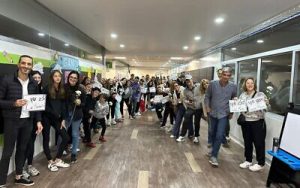
Eight students and two staff from World ORT’s operational arm in Israel who were stranded in the Czech Republic due to the Israel and Iran conflict have returned home on an emergency flight.

The group, which was part of a wider Israeli delegation of 60 students and 20 teachers who had been taking part in an international science accelerator competition in Prague, landed back in Israel on Friday morning [June 20]. They had been due to return to Israel a week earlier, but their plane had been turned back due to the closure of Israeli airspace on June 13.

Half an hour after arriving at Israel’s Ben Gurion Airport, the students and staff had to run to an airport bomb shelter because of emergency alerts during an Iranian missile bombardment.

Dr. Moshe Leiba, Chief Pedagogy and R&D Officer for World ORT Kadima Mada, said: “They landed 30 minutes before an attack – other planes were in the air so were turned back. Our group landed and had to run back to the shelter, and then they finally got home after driving more than an hour.”

Speaking before the group returned, he had said: “These are very challenging times. Our students, who are aged 13 and 14 and in Grade 8, are staying in an apartment we rented for them. We have arranged a full array of activities for them. All the groups are connected and there are meetings on a daily basis.

“We are also taking care of their mental health needs with our professionals (including me) and locals. I meet with staff and students on Zoom daily.”

The students and staff were looked after by World ORT Kadima Mada colleagues as well as staff and students from the ORT-affiliated Lauder School in Prague. Dr. Leiba added: “The Jewish community in Prague was amazing and gave its full support for every need.”

Lior Barzilay, vice-principal of the Junior High School at World ORT’s Kfar Silver Youth Village at Ashkelon, said: “It was a very stressful situation. We were shocked because we didn’t know what was happening in Israel, and we didn’t know how or when we were going to come back.

“But World ORT Kadima Mada, Dr. Moshe Leiba, Kfar Silver CEO Amos Gofer, and the program’s CEO Vered Cohen Barzilay, took care of everything behind the scenes so we could focus most of our attention on the children.”
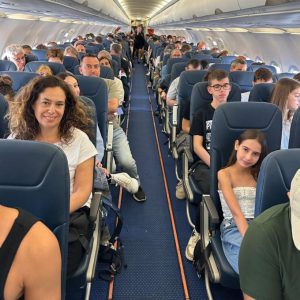
The Israeli students on the plane home

The Israeli students on the plane home

ORT America supporter Margie Green, of Florida, who has a long-standing connection to Kfar Silver, made a significant donation to help cover the costs of the students’ time in Prague and travel back to Israel.

The parents of these students wrote in a letter to Ms. Green of their “heartfelt appreciation”, adding: “Thanks to your help, our children had a safe and welcoming place to stay in Prague during uncertain and stressful times.

“Your care, generosity, and quiet strength made all the difference. You gave us not only practical help, but real peace of mind — and for that, we are truly grateful.”

Tzippi Becker, a teacher at Kfar Silver, said: “The Jewish community in Prague were very welcoming and students made us feel comfortable and showed us places in the city. They gave us kosher food, which, for a lot of people, was important.”

Lucie Hall, World ORT’s representative in Prague and a teacher at the Lauder School, said: “The school normally has around 400 students but needed to accommodate and feed an extra 80 people. Our school paid for their food, and Czech parents sent us contributions.”

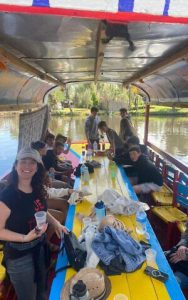
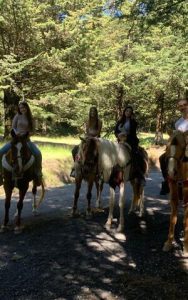
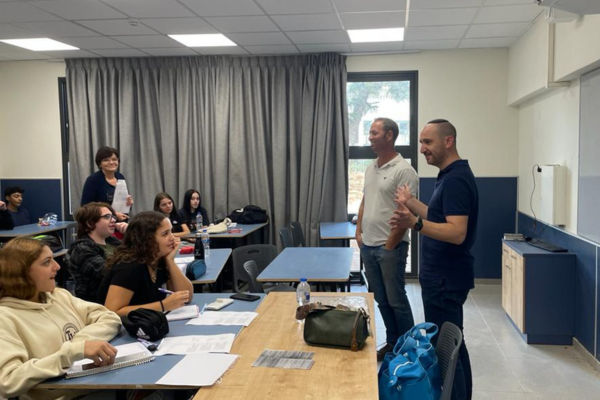
English and Hebrew teachers at the Prague school prepared a program for the students. During the week, students visited the school and attended lessons, played sport including football and table tennis, made pancakes and chatted to their Czech counterparts.
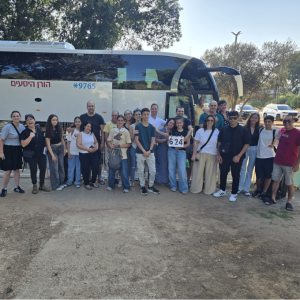
Kfar Silver students back in Israel

Kfar Silver students back in Israel

“Emotionally, they seemed to be fine when in school, but their teachers said they were up and down,” Ms. Hall said. “Sometimes it was emotionally exhausting for them – they were happy for two hours, then they were sad, possibly when they received news from their families.

“They were talking with the Czech students a lot about our school, about their situation, about their school in Israel,” said Ms. Hall.

Student Yonatan, who is 13 and studies at Kfar Silver , said: “It was a very good trip – I had a lot of fun and enjoyed meeting new people. The community treated us very well. Two of the older students showed us around Prague.”

Students attended the competition from all over the world, including Turkey, Ukraine, and Nigeria.
‘Creative Atmosphere Fills Me with Energy and Positivity to Teach Despite War’

Four educators from Ukraine pulled out all the stops in order to attend the World ORT Jewish Educators’ Seminar in Barcelona.

Yuliia Tkachuk, a Hebrew Teacher at Kyiv ORT School 141 and ORT Ukraine PR Manager, said it took her and her colleague, Oleksandra Shokhina, from Kyiv ‘ORT-Simha’ school, 36 hours to reach Barcelona.

Yuliia travelled by train to Chop, which is near the Ukrainian border, and then took another train to Budapest, from where she caught a plane to Barcelona. This took her nearly two days rather than the pre-war three-hour flight direct from Kyiv.

She said: “I would like to thank you from the bottom of my heart for the opportunity to join the seminar in Barcelona. For teachers from Ukraine, who are working in extremely difficult conditions today, it is not only a source of knowledge, but also an invaluable space for inspiration, exchange of ideas and professional growth.

“The knowledge gained during the seminar will have a significant impact on our work. New approaches to teaching, modern teaching methods and tools that we have learned will become the basis for creating a high-quality and effective educational process even in the most difficult conditions.

“An equally important aspect of the seminar was the development of soft skills. These skills are key in our work, as they help us find a common language with students, parents, and colleagues, adapt to changes and make non-standard decisions.

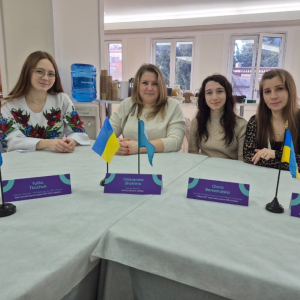
Yuliia Tkachuk, Oleksandra Shokhina, Olena Berezorutska and Anna Tarasiuk

“This seminar also became a platform for inspiration, as we not only exchanged ideas with our colleagues, but also felt real solidarity and support, which is extremely important for Ukraine today. This seminar breaks down walls between people and countries, helps to overcome barriers of misunderstanding and creates effective, and most importantly, much-needed bridges in the modern world.”

She thanked World ORT for its generous support, which also gave delegates the opportunity to be part of the global educational dialogue. “Without your help, many of us would not have been able to join this incredible event.”

Oleksandra said: “I am grateful for the opportunity to join the community of Jewish educators. This creative and friendly atmosphere inspires and fills me with energy that gives me the strength to teach children with a smile and positivity despite all the difficulties created by the war.

“The exchange of experience, international connections and implementation of joint plans, such as telebridges between schools, will give our students additional motivation and opportunity for development and learning.”

Meanwhile, it took Anna Tarasiuk, an English and Jewish Tradition Teacher from Bila Tserkva Private Lyceum ‘Mitsva-613’, two days to reach the seminar. She had to travel to West Lviv, then on to Rava Ruska, from where she took the train to Warsaw in Poland. She spent two hours waiting on this last train for her documents to be checked, after which she flew from Warsaw to Barcelona. A journey that would normally have taken three hours was extended due to the war.

Anna found the seminar instructive, saying: “I have gained a wealth of knowledge. My goal was to gather fresh ideas for new projects, implement them effectively, and foster collaboration with colleagues from around the world.

“The initiative to promote Jewish traditions in English within our high school is particularly inspiring. Perhaps we could organize Zoom classes with students from Israel or Spain, facilitating discussions on Jewish holidays. This would allow them to exchange knowledge while simultaneously practicing English. Moreover, the experience could extend beyond cultural discussions to leadership development. Many students tend to downplay their talents, but such initiatives could help them build confidence and express themselves more openly.

“I truly appreciated the seminar – it was thought-provoking and left me brimming with ideas. I particularly enjoyed the art workshop, which offers excellent opportunities for both primary and high school students.”

Olena Berezorutska, a Teacher of Jewish Traditions and Hebrew Language at Odesa ORT Zhabotinski Lyceum #94, travelled for 21 hours to reach the seminar – a journey that would normally have taken half that time. She travelled to Chișinău, the capital of Moldova, from where she took a flight to Istanbul, then another flight to Barcelona.

She said: “I was hoping for a supportive international community and to gain experience from everyone. I’m happy to be in the community of educators who are supportive and share my goals. I’m interested in initiatives that combine technology and English, for example, or integrate Jewish education and tradition within another subject and multidisciplinary subjects.

“I would recommend the seminar – it contains so much useful information, which we can apply in real-life scenarios, and I will adapt my approaches after the seminar. I hope to continue our communication because it was an incredible experience.”

Since the war began in 2022, ORT students, teachers and their families in Ukraine have faced attacks at home and at school. ORT has urgently raised funds to ensure continuity of education along with the provision of psychological support, financial aid, and essential resources. Schools have adapted with bomb shelters and remote learning and, despite the challenges, ORT Ukraine’s commitment to maintaining educational excellence remains steadfast.

Read more about ORT’s campaign for Ukraine


Ecology Summer School – A Hands-On Learning Experience in the Panama Rainforest

The 2024 World ORT Ecology Summer School has taken place in Panama. This regional summer school, which runs in Spanish, brings together ORT students from our Latin American and Spanish schools who are passionate about ecology.

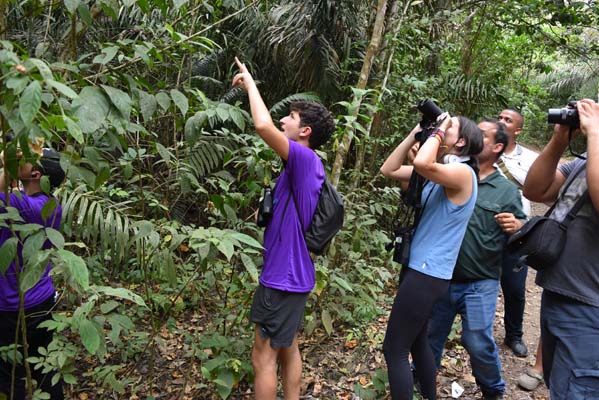
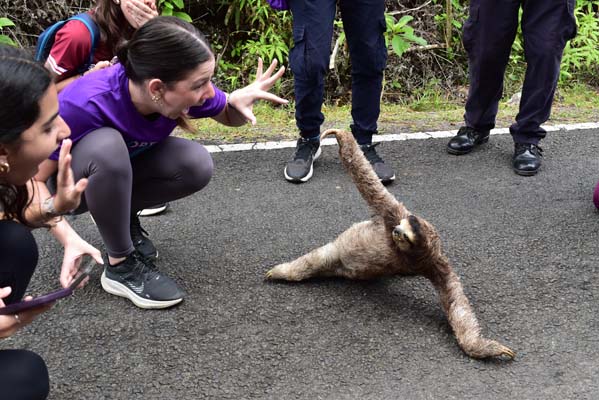
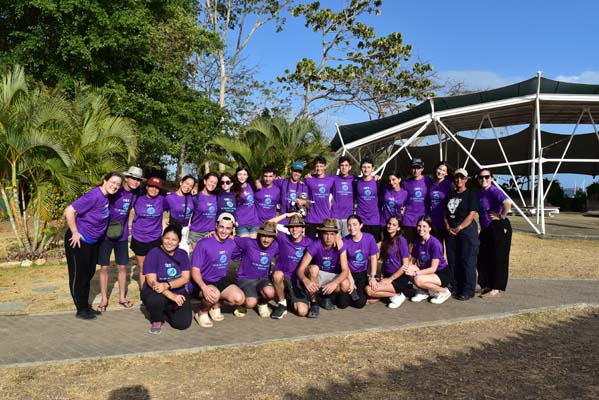
Twenty-one students aged 15-17 from Brazil, Colombia, Mexico, Panama, Peru, Spain, and Venezuela, along with ORT teachers Ximena Grandez Breña (Peru) and Tania Amilburu (Spain) spent two weeks in the Gamboa Rainforest in Soberania National Park, working with experts from the Smithsonian Tropical Research Institute and Adopta Bosque, a non-profit NGO promoting rainforest conservation, conducting scientific ecological research.

Guido Berguido, the founder of Adopta Bosque, along with his team of experts, Chelina Batista, Ana Portugal and Ryan Oniel, worked closely with the students and guided them through their hands-on and interactive, independent research study projects. The students immersed themselves in the rainforest and gained a firsthand experience of what it would be like to be a scientific researcher, collecting and analyzing data across a range of projects.

Daniel Tysman, Head of World ORT’s Education Department, summarized the trip and said: “Although they were only together for 12 days, these ORT students were quick to connect with each other and collaborated well on their research projects. They not only improved their scientific research skills, but gave expert presentations of their analysis of the data at the end of the process.

“We present them with the richness of the rainforests and encourage them to zoom in on the details. Through this process they develop a deeper understanding of the value of these incredibly complex but ultimately endangered ecosystems and their responsibility for conservation.”

Elias, aged 15, from Colegio ORT Olami in Mexico, said: “My highlight is the research that we did in the jungle. We spent three days, three hours a day in the jungle researching the information. I want to thank ORT for making this trip possible. It’s an amazing opportunity to meet new people and to learn a lot about mammals, birds, and plants.”

Dana, aged 15, from Colegio Moral y Luces ‘Herzl-Bialik’ in Venezuela, said her highlight was “when we went to the jungle in the middle of the night searching for bats and learning more about them”.


One of the unique aspects of this experience for the students was the opportunity to build bonds and form connections with peers from different countries, learning from each other and sharing their differences and similarities.

Karen, aged 16, from ORT Colegio Estrella Toledano in Madrid, Spain, said: “I have made a lot of connections with a lot of people here, but I would mostly have to highlight that we are all so different from each other, we talk differently, we have cultures and different tastes in music and food. Going on the buses to the different excursions, we saw a lot of that difference through music… I’ve learnt a lot of that from the people here.”

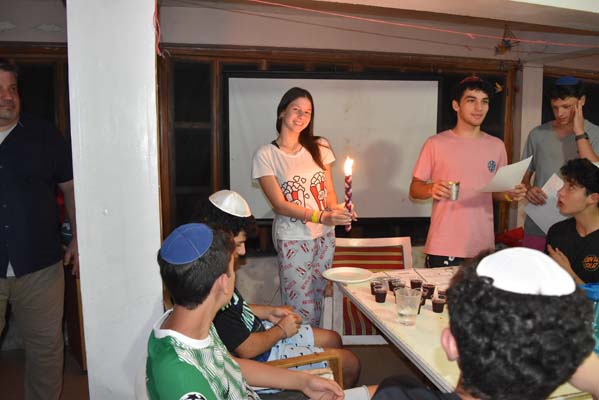
During the program the students experienced Shabbat – a great opportunity to see the connections they had formed. A mixture of students from different countries came together to lead a discussion session on Friday night, analyzing Jewish texts and concepts and engaging in a heart-warming Havdalah ceremony the following evening.

Ximena, an ORT teacher from Colegio Leon Pinelo, Peru, commented: “The Jewish community is very close to each other and help each other and experience everything together. Here I have seen even though we are from different countries, all students share the same Jewish culture and feeling. When we celebrated Shabbat everyone knew what they were talking about or most of them knew the songs and prayers, and all hugged each other. It was a very special moment for me as a teacher to experience and I feel very fortunate for that.”

Towards the end of the summer school, once the students had finished collecting their research and working together in the groups to analyze the findings, the students then presented their research projects to their peers and demonstrated their skills and learning from their experience.

The research projects included analyzing leaf-cutter ants with a group comparing the differences between the leaf-cutter ants in Pipeline Road and Sandero de la Laguna, analyzing if the ants prefer to carry branches and different types of leaves, seeds, and fruits between the two places. The second group researched lichen on trees and their relationship with the ants. This group compared three different sites and analyzed the percentage of ants in these places, specifically looking at the ant nests on the trees to see if there was a difference between the position of the nests.

The third group analyzed shrubs and plants, comparing the differences in height, width, composition of leaves, organisms inside the plants and plant colors between those close to water and those further away. The fourth group researched Azteca Ants, comparing the location of their nests on the trees. They were analyzing the quantity of nests, the height of the trees, looking at the relationship between other plants and animals, the shape of the nest, the position on the tree and the light and temperature around the environment. The final group researched the interaction between monkeys and the forest. They analyzed their eating habits, the monkeys’ relationships with other animals, their behavior and monkey group dynamics.

Galiana, aged 17, also from Venezuela, said: “After we did the investigation of finding each shrub in different areas and microhabitats, we found out they have different physical characteristics that identify them in their different areas. In the moist and in the dry areas we found out that the shrubs and bushes had differences in the quantity of their leaves and the health of them. We found out that if they are near to water, they have less damage in their leaves and if they are in a drier area, they’ll have more damage in their leaves. We also could identify their difference in height, and their difference in centimeter by diameter and we could also identify their differences in lichens, in fungus and in their color.”

Along with the high-level scientific concepts that the students were able to grasp and develop during their time on the program, they were also able to immerse themselves into the Panamanian culture and experience more of the country. When the students weren’t busy in the field they were also given the opportunity to explore the country and culture and the highlights of the trip included visiting the Panama Canal, meeting with the indigenous Embera-Wounaan tribe and learning about their culture, visiting historical sites of key importance such as Fort San Lorenzo and there were trips to Punta Culebra Nature Center where they learnt about marine life.

VIEW THE PHOTOS

WATCH THE YOUTUBE PLAYLIST

Watch the highlights

Ilan from Mexico, Ecology Summer School participant

Ximena, Teacher from Peru, Ecology Summer School

World ORT schools in Mexico, Bulgaria offer education and empathy for Israelis traumatized by war

This article first appeared in the Times of Israel

The month-long program at Colegio Olamí, geared for students aged 12-16, provided teens with plenty of opportunities for learning and socializing

Colegio Olamí ORT in Mexico City has introduced a transformative program for 25 Israeli high school students who were evacuated from their communities near Gaza, in the wake of the war in Israel.  The initiative, the brainchild of Olamí school principal Avi Meir, is part of global Jewish education network World ORT’s broader mission to support Jewish students, providing stable educational environments during challenging times.

The month-long program at Colegio Olamí, geared for students aged 12-16, provided teens with plenty of opportunities for learning and socializing, in both formal classes as well as extracurricular activities and trips. None of the guests knew Spanish, but as Orly Picker, the academic director at Olami, explained, “Kids manage! Between Hebrew and English, they were able to communicate beautifully with their host families and the other students.”

The Israeli students were matched in advance with families with a boy or girl of a similar age, giving parents and teens from both sides of the globe the opportunity to become acquainted over the phone. The Israelis joined their Mexican peers for many of the classes and after-school activities. Spanish classes, activities at the local Jewish sports center, and Mexican cooking classes were big favorites.


Some programs, though, were geared to the Israeli guests only, such as the group sessions led by a Hebrew-speaking psychologist, designed to give the teens space to express themselves freely. “Sometimes they wanted to talk, and other times they sang or wanted to just hang out,” said Picker.

There were a few cases of children who were still traumatized by the events of Oct. 7. “We had one girl who had trouble sleeping; and she didn’t have much of an appetite. We arranged professional, one-on-one help with an Israeli psychologist. By the following week, she was feeling better.”


It wasn’t always easy for the teens, accustomed to the relative freedom they enjoyed as Israelis and as kibbutzniks, to adjust to the life in Mexico. “At first, they couldn’t believe that we wouldn’t allow them to go out alone.” said Picker. “We had to explain to them very clearly, ‘No, you cannot travel on your own. This is Mexico City, and you are our responsibility.’”

One of the highlights was the visit to the synagogue on Friday night for Shabbat services, followed by a beautifully catered meal. “They were especially moved by the prayer for the soldiers, and four students asked to stay overnight at the home of the rabbi so that they could attend services the following day.”

Picker points out the generosity of the Mexican community, who picked up the tab for all outings and meals, and particularly the host families, who treated the teens as if they were their own children. The entire program was free of charge.

In January, Colegio Olamí will be welcoming another delegation of students from World ORT Kadima Mada’sKfar Silver Youth Village near Ashkelon, Israel, for a two-week program.

The school has also absorbed a group of 22 students from Israel on full scholarships. According to Amelie Esquenazi, the World ORT representative for Latin America, these are children of Mexican families who had previously made Aliyah, but have now fled war zones and who will be remaining indefinitely in Mexico.

Welcome to Sofia

Mirroring the efforts in Mexico, the ORT school in Sofia, Bulgaria, under the leadership of Director Plamen Petrov and Hebrew Coordinator Stella Dinkova, has also become a haven for children of Israeli families fleeing conflict. Following the outbreak of war, Bulgaria, long a popular destination for Israelis, has seen a significant influx of families, particularly from southern Israel.

“The local community in Sofia has provided families with an outpouring of essential support including food, clothing, toys, and housewares,” said Dinkova. As part of those efforts, ten children, aged 6-13, have been integrated into the ORT school, and have started to learn Bulgarian while continuing their Hebrew education and Jewish cultural studies.

This is a similar arrangement to one put in place by Dr. Petrov and his team after the outbreak of war in Ukraine last year. ORT students from that country were also absorbed into the Sofia school after being displaced by the violence.

Both the Mexican and Bulgarian schools highlight World ORT’s focus on education as a means of stability, growth, and healing for young individuals and families facing adversity. The network’s commitment to global solidarity and empathy across its schools, universities and extra-curricular programs in over 40 countries, stands as a beacon of hope and collaboration in challenging times.


‘We Are Regaining a Sense of Normality’ – Students and Teachers in Israel Deal With Impact of War

Students and teachers from ORT programs across Israel have explained how they are continuing their education despite the impact of the war.

During World ORT’s latest online briefing looking at our response to the aftermath of October 7, supporters worldwide heard how the focus has shifted to the long-term psychological needs of beneficiaries and the return to classroom learning where possible.

WATCH THE RECORDING

Dan Green, World ORT Director General and CEO, thanked international supporters for their financial and emotional backing since the deadly terror attacks seven weeks ago.

The ORT network has raised around $2 million to help our students, teachers and beneficiaries in Israel. He also referred to the solidarity and goodwill shown by colleagues worldwide.

Dan visited Israel to meet colleagues including Amos Gofer, CEO of our Kfar Silver Youth Village, and Dr. Moshe Leiba, Chief Pedagogy and R&D Officer of World ORT Kadima Mada, our operating arm in the country.

Dan said: “It was an incredibly inspiring, uplifting and positive experience for me. I spent some time with Amos and Moshe in Kfar Silver. To see our students coming back to school was fantastic because there was so much joy in their faces. To have this opportunity finally, having been either stuck at home or relocated around the country or being on Zoom. That was wonderful.

“It was also tinged of course with lots of sadness. We paid a condolence visit to one of the staff members of Kfar Silver, who very sadly lost her son fighting for the IDF. That was a tremendously humbling experience, meeting her and seeing her resilience, sharing pictures and stories about her dear son was a moment that I won’t forget.”

He paid tribute to staff “for the incredible work they have been doing – picking up the pieces, showing love and support and care for all of our students. It’s really been very humbling to see how they have worked during this critical time and I can’t thank them enough”.

Dr. Leiba explained how World ORT Kadima Mada staff were now working to assist more than 4,000 students across 44 evacuation centers in the country, providing counselling, psychological assistance and a range of physical therapies including sport and krav maga sessions.

He said the organization had switched from the immediate ‘first aid’ response of October to longer term services. Our extra-curricular YOUniversity courses have relaunched in Dimona and Kiryat Yam and more than 340 students will now be benefiting from dozens of permanent courses.

“We are regaining a sense of normality,” Moshe said.

Joining the call from Kfar Silver, Amos Gofer explained how students were returning to the village in limited numbers. Around 180 boarding students are now back living on site – around 75 per cent of the total regular number of boarders. Some overseas students returned to their home countries in the initial aftermath of October 7 but it is hoped almost everyone will be back in the village after Chanukah.

He said classes are being staggered so that day students can be in the village at least twice a week for their lessons.

Amos said: “The spirit is strong. Some staff lost dear family members so it is obvious they are not in a good emotional condition, but almost everyone else from the staff is back working in the village.”

Dana Dahan, Manager of the Western Galilee Center, who was evacuated seven weeks ago from her kibbutz on the northern border with Lebanon, described how she and colleagues are now providing robotics, animation and other activities for children in evacuation centers in the area.

“The students are really happy to see us when we go to the centers,” she said. “It gives them something aside from their schooling, which are not yet their regular courses. So our activities are really pleasing them.”

The briefing was completed with the moving testimony of two students. Uriyah, is from Kibbutz Zikim just a couple of kilometers from the Gaza border where terrorists infiltrated, Uriyah was evacuated from his home and described how in addition to resuming some classes at Kfar Silver, he has also been attending extra classes online in the evenings to ensure the war does not disrupt his education.

Uriyah added: “I know I am still part of the programs the school and World ORT offer me, like the Taub Young Entrepreneur Program (YEP) and the young ambassadors, so I will continue to represent the school wherever I am.”

And Sviatoslav, a Kfar Silver boarder, told viewers he had returned to Kfar Silver this week. He is able to work in his room during the day but sleeps in a classroom, with other students, next to a safe room at night. Between 15 and 20 students sleep in each classroom.

As an educational organization, ORT strives to provide our students with the strength and support to learn and grow. Now we must also help them process the trauma they are experiencing and build resistance to the horrors of terrorism and war.

Please help us to provide urgent educational and psychological support for students, teachers and their families across Israel.

DONATE TO THE EMERGENCY CAMPAIGN

Ongoing Challenges as Ukrainian Students Return to Classrooms

Thousands of ORT students are returning to their classrooms across Ukraine this month, despite the continuing attacks on the country.

Many will be enjoying lessons in person for the first time since the start of the war more than 18 months ago. Others are continuing to take part remotely, using online learning platforms.

All ORT schools in the country have opened the academic year with face-to-face classes running alongside hybrid options, except in Odesa and Zaporizhzhia, which remain too close to the front line and face a wider range of security issues.

Shoshana Kandel, Head of World ORT’s International Coordination Unit, said: “The impact of the war is still heavily felt at all our schools. A significant number of people have fled their home cities and are currently categorized as ‘internally displaced’ – effectively as refugees within their own country. Others who left Ukraine soon after February 2022 remain abroad but are also restarting classes online.”

Ukraine’s children have faced significant learning loss due to repeated setbacks since 2020. They are now entering their fourth consecutive disrupted academic year. A recent UNICEF report revealed that 57% of Ukrainian teachers have seen a deterioration in their students’ Ukrainian language abilities. Up to 45% have lost skills in math and more than half have deteriorated in foreign languages.

ORT schools appear to be faring better thanks to the direct support provided, teacher training and the efforts taken to protect students during their time on-site at school. Parents have reported these as being among the reasons they have registered their children to learn at reopening ORT schools.

The huge influx of people to Kyiv means that at the city’s ORT Educational Complex #141, a new class has opened in the 6th grade entirely to accommodate children who have moved to the city.

The school basement is undergoing major refurbishment works, similar to in many older buildings in Kyiv, to make it suitable for use as a shelter. The plans will allow the school to bring back all children whose families want them to engage in face-to-face learning. The complex works are expected to be finished in the coming weeks.

To further ensure safety and maintain a sensible balance of students in the school at any time, the high school is encouraging more distance-learning days for teenagers. The total number of students resuming in-person classes is now more than 1,000 – almost double the number from the last academic year.

At the Jewish State Educational Complex ‘ORT-Simha’, also in Kyiv, the balance is different, with the majority of the school’s 350-plus students remaining abroad and learning online.

At our schools in Chernivtsi and Bila Tserkva, the majority of families and children have returned home and are back to in-person schooling.

Unfortunately the circumstances in Odesa and Zaporizhzhia remain more critical. The government is overseeing the renovation of a basement at the Odesa ORT Zhabotinski School #94 with the intention of completing the work by October 1.

Ms Kandel added: “We are hopeful that the school will return to in-person classes by mid-October, pending the successful completion of these renovations. Our main need will be to restock the shelter and purchase necessities such as furniture, mattresses, blankets, warm clothes, and food supplies.”

An alternative building is being sought for the ORT ‘Aleph’ Jewish Gymnasium in Zaporizhzhia. Constant air strikes on the city are making it hugely challenging to find premises with suitable shelters for students and staff and are also disrupting online learning. Around 425 ORT students in the city are registered for the new school year.

In total, ORT Ukraine expects to educate around 3,800 students this year – although the number is ever- changing due to the circumstances. Around 400 ORT teachers will be guiding our students, with all but a handful working in Ukraine.

“Maintaining Jewish education is a major concern for us,” said Ms Kandel. “This is due to the ongoing shortage of Jewish studies teachers from Israel and the lack of local teachers specializing in Jewish studies.

“Ukrainians are already looking ahead to the winter with concern. It is likely that in Odesa the resumption of in-person classes will require new equipment and electrical repair work – a more powerful generator may be necessary. Greater use of these facilities will likely lead to additional challenges and the need for more repairs and funding.”

Ukrainian students travel to Bulgaria for digital summer school

This article first appeared in Jewish News Syndicate.

Ukrainian students travel to Bulgaria for digital summer school

The two-week program, taught by skilled professionals, deepens students’ experience in photography, video and audio production.

Three Ukrainian teens took part in a summer school in Bulgaria after World ORT facilitated their departure from the war-affected country to join peers for the chance to learn digital skills.

It took more than 24 hours as they crossed thousands of kilometers by road and then rail from their Ukrainian home cities—first across the border to Poland and then by plane to Sofia.


Polina Tymofieieva, 16, records a song she wrote about Ukraine, August 2023. Credit: World ORT.

Natan Hen from Bila Tserkva in the Kyiv region and Ihor Belinskiy from an ORT school in Kyiv, both 15, as well as 16-year-old Polina Tymofieieva, who traveled furthest from the ORT school in Zaporizhzhia, participated in the World ORT Digital Skills Academy.

The two-week program, taught by skilled professionals, deepens students’ experience in photography, video and audio production. Natan studied video editing; Polina took an audio production course; and Ihor focused on photography skills.

Anna Chumakova, an ORT Ukraine staff member based in Kyiv, joined the trio on the journey and at the camp. She said that “the kids were so excited to take part. Combining the opportunity to have a distraction from life at home and the constant air raids with the chance to learn so much and have this priceless experience was really an amazing thing.”

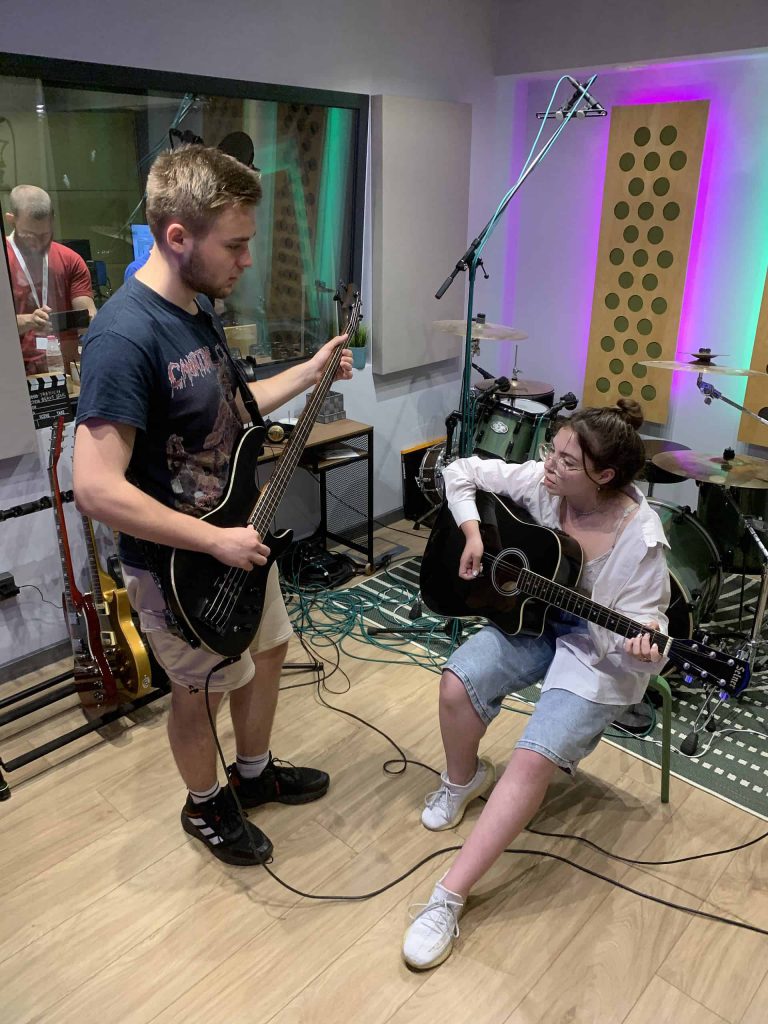
During the camp, Polina played guitar and recorded a Ukrainian song about hope and the future in a professional-standard studio. A fellow student attending the summer school from Lithuania filmed the experience and created a short video for social media.

“The summer school was an opportunity for me to distract myself from the reality of life in Ukraine and to gain a lot of new knowledge to help build my future career,” she said. “We worked so enthusiastically on our projects and attained a really high level.”

“The camp had an atmosphere of peace, mutual support and friendship. It was a place where dreams could come true. I had always dreamed of recording a song in a professional studio. I was so pleased we recorded a Ukrainian song; it was very important for me. I have a lot of precious memories from this summer school.”

Ihor’s work featured experimental approaches to the use of light in photography and images of his fellow camp participants.

 “Thank you to the new friends and teachers who were with us all the time,” he said. “I had a lot of fun, and I’ll remember this—the memories will stay in my heart.”


Teens from Ukraine with others at a summer school in Bulgaria that focused on photography, video and audio production. Credit: World ORT.

World ORT helps Ukrainian teens enjoy summer school abroad

This article first appeared in The Jewish News.

World ORT helps Ukrainian teens enjoy summer school abroad

The program deepens ORT students’ experience in photography, video and audio production taught by professionals.

World ORT, a global education network driven by Jewish values and innovation, has helped three Ukrainian teens participate in a summer school in Bulgaria by facilitating their departure from the war-torn country. 

The three students, Natan, 15, from Bila Tserkva in the Kyiv region, Ihor, 15, from an ORT school in Kyiv and Polina, 16, from the ORT school in Zaporizhzhia, traveled thousands of kilometres across the border to Poland, and then flew to Sofia in Bulgaria to attend the two-week program.

The program deepens ORT students’ experience in photography, video and audio production taught by professionals. Ihor chose to focus on photography skills, Natan studied video editing, and Polina took an audio production course.

Anna Chumakova, an ORT Ukraine staff member based in Kyiv, joined the the three teenagers, saying they were “so excited to take part.”

“Combining the opportunity to have a distraction from life at home and the constant air raids with the chance to learn so much and have this priceless experience, was really an amazing thing,” Chumakova added.


Polina, Natan and Ihor traveled thousands of kilometres on the road across the border to Poland, and then flew to Sofia in Bulgaria to attend the two-week program. Credit: World ORT

Polina said the summer school was an opportunity for her to distract herself from “the reality of life in Ukraine – and to gain a lot of new knowledge to help build my future career. We worked so enthusiastically on our projects and attained a really high level.”

“The camp had an atmosphere of peace, mutual support and friendship. It was a place where dreams could come true. I had always dreamed of recording a song in a professional studio – I was so pleased we recorded a Ukrainian song, it was very important for me. I have a lot of precious memories from this summer school,” she added.

Ihor expressed his gratitude to his new friends and teachers, saying: “The memories will stay in my heart.”

Throughout the 18-month-long war in Ukraine, World ORT staff and supporters across ORT’s global education network have worked to support the thousands of ORT Ukraine students, teachers, staff and their families affected by the violence.

“Natan, Ihor and Polina have had a life-changing opportunity – gaining valuable digital skills that will give them a head-start as they look to build their careers in digital industries,” Dan Green, World ORT Director General and CEO, said.

“This is at the heart of what ORT has done for more than 140 years. Adapting to ensure we continue this provision during a time of conflict is something that brings me and our professional team enormous pride,” he added.

Talking leadership: Jorge Grünberg on creating entrepreneurs

This piece first appeared on the Times Higher Education website here.

The rector of ORT Uruguay, cradle to the country’s first ‘unicorns’, talks about fostering an entrepreneurship mindset in a risk-averse society

Each morning, Jorge Grünberg, rector of the technology-focused university ORT Uruguay, begins his day by flipping through Uruguay’s national newspaper. He often stumbles across familiar names.

Take a recent article about a young entrepreneur – a biotech engineer and ORT alumna – who, since graduating, has founded her own company to find new ways of treating chronic inflammation diseases. Hers is just one of dozens of success stories that he believes illustrate his university’s contribution to the country and Latin America.

Located in Uruguay’s capital city of Montevideo, ORT is a private institution. It scores in the 151+ band in Times Higher Education’s Latin America University Rankings 2023 – and is the only university in the country to be featured in the league table.

Innovation runs in the university’s veins. ORT’s Centre for Innovation and Entrepreneurship runs an incubator for companies and teaches students how to launch their own businesses, assess ideas and secure start-up capital. Students are encouraged to take “an entrepreneurial attitude”, based on the belief that youth is the time for risk-taking and experimentation.

While that may seem like the standard modus operandi for Silicon Valley, in Latin America’s risk-averse society, ORT breaks the mould, according to Grünberg.

“When we promote this we are being, in a way, counter-cultural,” he says.

It’s something Grünberg is familiar with, having done his degree in computer engineering back in the 1970s, when it was considered “exotic” in his country.

He believes Uruguay and Latin America have “a general problem with entrepreneurship”. Instead, the culture leans toward securing a place as an employee, especially one that works for the state, he says. That couldn’t be more different from ORT’s approach.

In November last year, Bloomberg News described the university as “a cradle for unicorns” after the country’s first three “unicorns” – companies to receive a $1 billion (£800 million) valuation – were born out of the university, one of them incubated in its entrepreneurship centre and the other two launched by ORT alumni.

An average of 10 companies a year now grow out of the institution, Grünberg says. The process often begins in students’ final year of study, when they are nudged to think about their projects or dissertations as business plans. They pitch these ideas to the incubation centre; the best ones are picked. The university then helps the students get in touch with investors and can often secure seed funding in the region of $30,000 to $40,000.

The resulting companies are more than business success stories, Grünberg believes. For ORT’s graduates, they’re a way up. The university’s focus on technical education in engineering, computers and design makes it a vehicle for social mobility.

More than 10,000 students strong, it produces programmers, web designers, data analysts and cyber-security specialists, feeding into a job market where digital and quantitative jobs are in great demand. ORT’s graduates are highly sought after, with an employment rate of 97 per cent after graduation.

In part, it has tapped into an unmet need in the country – one that the government in Montevideo recognises. In early 2023, responding to an IT-worker deficit and a brain drain in the industry, Uruguayan policymakers proposed a system of tax benefits to attract IT professionals and companies.

“The story of our graduates is very heartening for us,” says Grünberg. Students from the lower middle class, he says, often the children of taxi drivers or cleaners, have finished university to become the highest-earning members of their families when they graduate.

“The pyramid of income in the family goes upside down,” he says. Even in their early 20s, alumni are able to help their parents with rent, buy them bigger houses or even move them to better neighbourhoods.

“This sort of mobility, leveraged by education and job opportunity, that’s what we are all about,” he says of the institution.

It can also help learners to find a way around the trappings of class division.

“When we bring them to ORT and give them the opportunity to study and connect them with companies, we are basically providing them with a safe route out of crime. And out of the illusion of elite football, which is only for a few,” says Grünberg.

Uruguay’s higher education system comprises six universities – two public and four private ones, including ORT. Public education is free and accounts for the majority of students. Grünberg says that despite this, ORT’s student body is not very different from that of its state-funded counterparts. This is because two thirds of students are on some form of scholarship. Scholarships and salaries, he says, make up the bulk of the university budget; further funding is raised through private donations. Grünberg adds that students also find the return on their investment in a technical education degree “gets repaid very quickly”.

However, “a terrible truth” persists for education in Uruguay, according to the rector. The country’s universities – both public and private – have remained a place for the middle class. Those who are extremely poor rarely finish high school, let alone higher education.

In the wider context of Latin America, Uruguay has the least inequality. The country, which is one third the size of France, “stands out in Latin America for being an egalitarian society and for its high income per capita”, according to the World Bank.

Grünberg attributes this to the government’s investment in building schools and making basic education free in the early decades of the 20th century, which meant that there was a “minimum level of education that excluded extremes”. Compared with its neighbours, Uruguay has a smaller gap between the very rich and the very poor. As of 2022, the World Bank reported that 60 per cent of the population was middle class – the largest in America, in relative terms.

Currently, its major challenge is raising education levels for the technological age, Grünberg says.

“If you know how to read and write, it’s not enough. Now you need more. You need a degree [from a] university. You need continual education through your life. You need to speak English. You need a lot of things that were not considered in the first social contract of Uruguay in the first decades of the 20th century.”

Adult literacy levels stand at 99 per cent, according to Unesco data.

“Uruguay is now trying to find out how to face this new challenge of going to the next step – from being literate in the sense of the 20th century to becoming literate in the sense of the 21st century,” Grünberg says.

Already a tourist hub, it has the potential – and plenty of ready infrastructure – to become an education hub for Latin America, he believes. Outside the busy holiday season from December to February, thousands of apartments lie vacant. “Students could use all this infrastructure that gathers dust, nine or ten months a year,” he says.

As the country’s institutions gain repute, Grünberg hopes learners from the broader region, including Mexico, Columbia and Peru, will consider moving to his country for graduate and postgraduate studies, making it a popular destination for overseas learners.

“University education could really be an export industry for Uruguay. It could be like Australia,” he says.

Learning from Others Ahead of World Refugee Day

Every year around the Seder table, Jews ask the question ma nishtana, why is this night different? Without giving too much away, the answer is essentially because we are free.

The Exodus story marks the liberation from Egypt of the slaves who then marched with Moses into the wilderness in search of a new beginning. This story of migration, fleeing persecution and creating a new identity, although occurring some 3,000 years ago, holds strong relevance in the current day.

On Pesach we eat maror and dip bitter herbs and recount stories of the Warsaw Ghetto in 1943; and the unfortunate fact is that today we are facing a global crisis of displaced people. In the first months of 2022, the number of people forced to flee war, violence and persecution worldwide surpassed 100 million for the first time according to the United Nations.

More than 100 students from across ORT’s school network – including in Panama, France, Spain, Mexico and Argentina – joined a special online session on April 20, the week after returning to school from the Pesach holidays, to hear three displaced women speak on their experiences of leaving home and arriving in a new country and having to adapt to carve out a new future for themselves.

This event was part of World ORT’s Global Citizenship International Events series. Global Citizenship is centred around the growing need for new skills and attitudes in our rapidly changing world, together with a focus on addressing the issues of our time. A first-hand engagement with the lived refugee experience engaged the students with a wider lens of humanity, nurturing empathy and other humanistic values.

The students heard from two Afghan women: Sadaf who had left six years ago and settled in Greece, and Mehreen, who had only left 18 months ago and who currently resides in Albania. We also heard from Sofia, a young Ukrainian who has made her home in Bulgaria.

After briefly sharing an overview of their experiences leaving their home countries, the students asked questions such as ‘what do you miss about your culture and traditions?’ and ‘have you experienced any form of discrimination?’. These pertinent questions, along with the emotional and inspiring answers from the panel, gave a real depth of insight.

These incredible women have all been beneficiaries of ORT projects, either through schools directly or the International Cooperation (IC) initiatives at the Irida Women’s Center in Thessaloniki or the Tirana Training Center. They spoke of their ambitions for their careers and study and ahead of World Refugee Day in June, we celebrated the courage of these women and felt inspired by their stories and words of wisdom: “Never give up in your life, it’s up to us to build our goals and our future dreams. For example, I have faced a lot of failures in my life, a lot of failures, and this was not the end point. I just stand up again and continue.”

They reminded us to be compassionate and remember that all people are seeking the ability to determine their own future and we should open our hearts, and perhaps the door, like we do for Elijah.