ORT Seminar was a ‘Catalyst for Growth, Connection, Inspiration’

Educator Juan Carlos Porras from the Instituto Dr. Jaim Weizman, Costa Rica, reflects on his experience of a World ORT program in Mexico City.

Participating in World ORT’s Global Citizenship Education (GCE) seminar was an incredibly enriching experience that exceeded all my expectations. I arrived at the event full of anticipation, eager to dive into new ideas and connect with fellow educators passionate about promoting global citizenship.

Although I had previously been a mentor in the YEP program, this was my first time attending an in-person ORT event, and I was excited to engage directly with the ORT community.

From the very beginning I felt truly welcomed. Everyone from the organization greeted us warmly, making us feel like part of a close-knit family. The sense of unity was clear from our first dinner together, even before the official activities started. There was an immediate connection among participants, which created an atmosphere of collaboration and open-mindedness. Sharing stories and experiences during that initial meal set a positive tone for the days ahead, breaking down barriers and fostering new friendships.

The talks were deeply inspiring, filled with real examples of how GCE can be applied in everyday life. The speakers didn’t just share theories; they presented practical insights, success stories, and challenges, making the concepts relatable and actionable. Seeing the passion the guest speakers had for their projects was especially motivating.

The days were busy and energizing, packed with well-planned activities designed to make the most of our time. From morning sessions to evening reflections, every moment was used effectively. Despite the full schedule, the energy remained high, thanks to the excellent organization and the shared dedication of everyone involved.

Holding the seminar at Colegio Olamí ORT was a very meaningful experience. We got to see GCE in action – not just through the activities we were doing but also by observing how the school operates and prepares its students to be global citizens aware of the world around them.

Experiencing the school’s approach firsthand was eye-opening. We joined classroom activities, interacted with students, and saw innovative teaching methods that integrated GCE principles seamlessly. Building water filters with students in the Maker Space was a highlight – not just a hands-on project, but a real example of addressing global issues like water scarcity. Seeing the students’ enthusiasm and understanding of global challenges reinforced the impact of GCE on young minds.

All the activities were thoughtfully organized, balancing theoretical lectures with hands-on learning. On a personal level, the experience was profoundly moving and touched me deeply. The visit to the Casa Tochan Migration Center was especially impactful. Hearing personal stories from migrants gave us profound insights into global and local issues, highlighting the human side of topics often discussed in abstract terms. The tour of the Museum of Memory and Tolerance was both sobering and inspiring, emphasizing the importance of tolerance, human rights, and learning from history to build a better future.
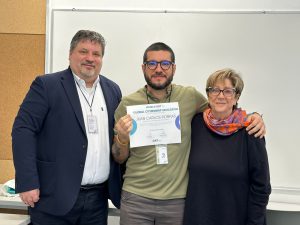
Juan Carlos at the end of the seminar with Daniel Tysman, Head of Education Department, and Amelie Esquenazi, World ORT Representative for Latin America

The group of participants was fantastic: educators from different backgrounds and countries, all united by a common goal. There was always a strong sense of camaraderie, and meaningful conversations could happen at any time – during sessions, meals, or informal gatherings. We shared professional experiences, personal stories, cultural perspectives, and educational philosophies. One of the most valuable takeaways is the network of contacts and friendships formed during the seminar. I feel that all the schools present truly left with the understanding that we are a global community that needs to work together.

We immersed ourselves in the vibrant culture of Mexico. Exploring Mexico City, enjoying its cuisine, and experiencing its rich history added an extra dimension to the seminar. We visited local landmarks, engaged with the community, and embraced the city’s energy, leaving us captivated by its beauty and spirit.

This experience not only strengthened my commitment to Global Citizenship Education but also had a profound effect on my personal and professional outlook. I return to my school with renewed enthusiasm, equipped with new strategies, resources, and a broader perspective on integrating GCE into our curriculum. The seminar reaffirmed the importance of fostering global awareness, empathy, and responsibility in our students. I’m excited to share these insights with my colleagues and to start collaborative projects with the new connections I’ve made.

In looking back, the seminar was more than an educational event; it was a catalyst for growth, connection, and inspiration. It reinforced the idea that education is a powerful tool for change and that as educators, we have the responsibility and privilege to shape the next generation of global citizens. I’m grateful for the opportunity to participate, and look forward to continuing the journey of promoting Global Citizenship Education in our schools and communities.

Juan Carlos Porras is a design teacher and integrator of technological education at the ORT-affiliated Instituto Dr. Jaim Weizman in Costa Rica
Global Citizenship Education: Making Mensches in a Modern World  

We nurture our children to be mensches. Today, across our global network of ORT schools, we prioritize Global Citizenship Education as a catalyst to that end.

At Colegio Olamí ORT in Mexico City this month, educators from around Latin America, including Peru, Panama, Mexico City, Colombia and Costa Rica, convened to take a deep dive into Global Citizenship Education (GCE), one of World ORT’s flagship programs.  

This enriching professional development opportunity took educators on a journey to explore the different facets of GCE, equipping them with the tools to foster a sense of global awareness and responsibility among their students, integrating the principles into classroom lessons and their school culture. The seminar featured a rich program of discussions led by experts in the field, collaborative activities and interactive workshops to enlighten and inspire participants.  

Defining Global Citizenship Education

The seminar featured expert-led discussions that guided the participants to develop a theoretical foundation for the definition of GCE. Participants explored the broad definition of GCE, honed in on ORT’s focus, and crafted a personalized definition relevant to their schools.

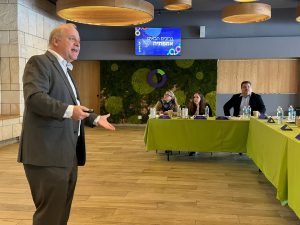
Dr. Moises Salinas Fleitman, Rector of Universidad ORT Mexico, delivered the keynote presentation, “Why Global Citizenship Education?”. 

Another popular session with the participants was led by Dr. Tamara Kolangui, Director for the Shimon Peres Chair for Peace, titled: “What is Peace Education and How is it Connected to Global Citizenship Education?” 

Dr. Moises Salinas Fleitman, Rector of Universidad ORT Mexico, delivered the keynote presentation, “Why Global Citizenship Education?”.

A Case Study: Colegio Olamí ORT

Participants put theory into practice and delved into how GCE might look in their own schools. 

They used Colegio Olamí ORT as their learning lab, touring the school with staff to investigate how Olamí, which is heavily invested in GCE, makes it come to life. 

Orly Picker and Mariana Piven, educational leaders at the school, demonstrated how their teachers explore global citizenship with their students through the educational model of project-based learning. 

Jorge Arditti, Founder of the We Are Water Foundation, spoke about innovative education on water issues, followed by the group working alongside students in the school’s Maker Space to collaboratively build a water filter like those seen around the school.

The humanitarian organization CADENA led an interactive workshop showcasing Olamí students and their involvement in the organization and left with an invitation to bring CADENA programming to our ORT schools.  

GCE in our World 

Participants zoomed out and explored GCE both on a communal and global level. The group was transported outside of the four walls of the Olami classrooms to witness first-hand Global Citizenship in Mexico City. Hearing personal narratives at a site visit to Casa Tochan Migration Center inspired our educators to think about how to bring local issues into their own students’ lives.  

The group also visited the Museum of Memory and Tolerance, whose mission is to disseminate the importance of tolerance, non-violence, memory and human rights. They had a private tour of the exhibits and met with museum staff to hear all that they have to offer to bring the museum to their schools through curriculum, virtual tours of the exhibits and webinars. 

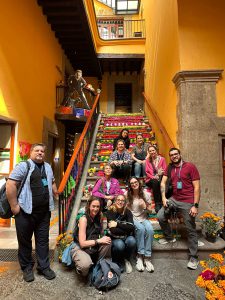
The group of educators on location in Mexico City

Next Steps

At the conclusion of their intensive study, these newly formed thought partners collectively chose joint projects to move forward in our Latin American schools, using the new information and resources acquired during the seminar. 

Our seminar participants who came as individuals definitely left Mexico City as a community of practice ready and highly motivated to roll up their sleeves to integrate Global Citizenship Education into their schools. 

Conversations that sprouted wings at the seminar about collaborative programming and individual projects will plant roots back at schools in the weeks to come.

Ecology Summer School – A Hands-On Learning Experience in the Panama Rainforest

The 2024 World ORT Ecology Summer School has taken place in Panama. This regional summer school, which runs in Spanish, brings together ORT students from our Latin American and Spanish schools who are passionate about ecology.

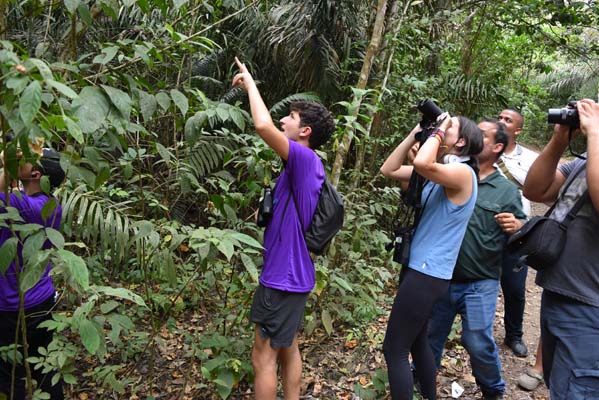
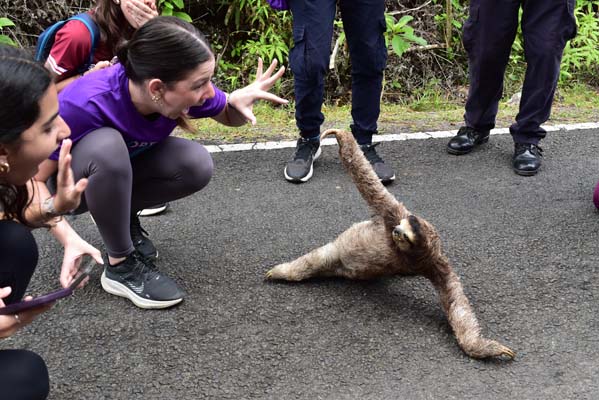
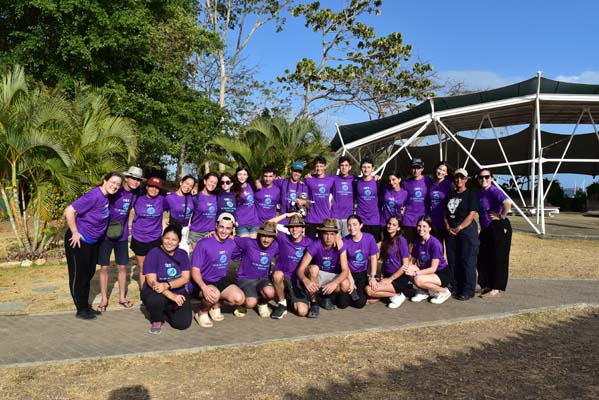
Twenty-one students aged 15-17 from Brazil, Colombia, Mexico, Panama, Peru, Spain, and Venezuela, along with ORT teachers Ximena Grandez Breña (Peru) and Tania Amilburu (Spain) spent two weeks in the Gamboa Rainforest in Soberania National Park, working with experts from the Smithsonian Tropical Research Institute and Adopta Bosque, a non-profit NGO promoting rainforest conservation, conducting scientific ecological research.

Guido Berguido, the founder of Adopta Bosque, along with his team of experts, Chelina Batista, Ana Portugal and Ryan Oniel, worked closely with the students and guided them through their hands-on and interactive, independent research study projects. The students immersed themselves in the rainforest and gained a firsthand experience of what it would be like to be a scientific researcher, collecting and analyzing data across a range of projects.

Daniel Tysman, Head of World ORT’s Education Department, summarized the trip and said: “Although they were only together for 12 days, these ORT students were quick to connect with each other and collaborated well on their research projects. They not only improved their scientific research skills, but gave expert presentations of their analysis of the data at the end of the process.

“We present them with the richness of the rainforests and encourage them to zoom in on the details. Through this process they develop a deeper understanding of the value of these incredibly complex but ultimately endangered ecosystems and their responsibility for conservation.”

Elias, aged 15, from Colegio ORT Olami in Mexico, said: “My highlight is the research that we did in the jungle. We spent three days, three hours a day in the jungle researching the information. I want to thank ORT for making this trip possible. It’s an amazing opportunity to meet new people and to learn a lot about mammals, birds, and plants.”

Dana, aged 15, from Colegio Moral y Luces ‘Herzl-Bialik’ in Venezuela, said her highlight was “when we went to the jungle in the middle of the night searching for bats and learning more about them”.


One of the unique aspects of this experience for the students was the opportunity to build bonds and form connections with peers from different countries, learning from each other and sharing their differences and similarities.

Karen, aged 16, from ORT Colegio Estrella Toledano in Madrid, Spain, said: “I have made a lot of connections with a lot of people here, but I would mostly have to highlight that we are all so different from each other, we talk differently, we have cultures and different tastes in music and food. Going on the buses to the different excursions, we saw a lot of that difference through music… I’ve learnt a lot of that from the people here.”

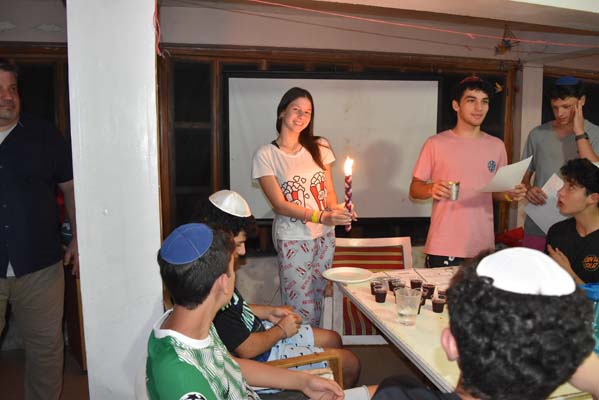
During the program the students experienced Shabbat – a great opportunity to see the connections they had formed. A mixture of students from different countries came together to lead a discussion session on Friday night, analyzing Jewish texts and concepts and engaging in a heart-warming Havdalah ceremony the following evening.

Ximena, an ORT teacher from Colegio Leon Pinelo, Peru, commented: “The Jewish community is very close to each other and help each other and experience everything together. Here I have seen even though we are from different countries, all students share the same Jewish culture and feeling. When we celebrated Shabbat everyone knew what they were talking about or most of them knew the songs and prayers, and all hugged each other. It was a very special moment for me as a teacher to experience and I feel very fortunate for that.”

Towards the end of the summer school, once the students had finished collecting their research and working together in the groups to analyze the findings, the students then presented their research projects to their peers and demonstrated their skills and learning from their experience.

The research projects included analyzing leaf-cutter ants with a group comparing the differences between the leaf-cutter ants in Pipeline Road and Sandero de la Laguna, analyzing if the ants prefer to carry branches and different types of leaves, seeds, and fruits between the two places. The second group researched lichen on trees and their relationship with the ants. This group compared three different sites and analyzed the percentage of ants in these places, specifically looking at the ant nests on the trees to see if there was a difference between the position of the nests.

The third group analyzed shrubs and plants, comparing the differences in height, width, composition of leaves, organisms inside the plants and plant colors between those close to water and those further away. The fourth group researched Azteca Ants, comparing the location of their nests on the trees. They were analyzing the quantity of nests, the height of the trees, looking at the relationship between other plants and animals, the shape of the nest, the position on the tree and the light and temperature around the environment. The final group researched the interaction between monkeys and the forest. They analyzed their eating habits, the monkeys’ relationships with other animals, their behavior and monkey group dynamics.

Galiana, aged 17, also from Venezuela, said: “After we did the investigation of finding each shrub in different areas and microhabitats, we found out they have different physical characteristics that identify them in their different areas. In the moist and in the dry areas we found out that the shrubs and bushes had differences in the quantity of their leaves and the health of them. We found out that if they are near to water, they have less damage in their leaves and if they are in a drier area, they’ll have more damage in their leaves. We also could identify their difference in height, and their difference in centimeter by diameter and we could also identify their differences in lichens, in fungus and in their color.”

Along with the high-level scientific concepts that the students were able to grasp and develop during their time on the program, they were also able to immerse themselves into the Panamanian culture and experience more of the country. When the students weren’t busy in the field they were also given the opportunity to explore the country and culture and the highlights of the trip included visiting the Panama Canal, meeting with the indigenous Embera-Wounaan tribe and learning about their culture, visiting historical sites of key importance such as Fort San Lorenzo and there were trips to Punta Culebra Nature Center where they learnt about marine life.

VIEW THE PHOTOS

WATCH THE YOUTUBE PLAYLIST

Watch the highlights

Ilan from Mexico, Ecology Summer School participant

Ximena, Teacher from Peru, Ecology Summer School

‘Creating a Better Vision of the Future’ – ORT Students Join Pope’s Global Event

ORT students have joined a global interfaith event that encouraged them to learn more about themselves and their peers.

The sixth Scholas World Youth Encounter took place in Sao Paulo for four days, with more than 100 international students promoting tolerance and intercultural dialogue. Fifty ORT students attended from nine countries: Argentina, Brazil, Bulgaria, Mexico, Panama, Peru, Spain, South Africa, and Ukraine.

The event opened with an opportunity to share cultures, languages and to dance together. Students taught each other how to sing ‘happy birthday’ in their own languages.

Pope Francis shared a message with the students in a recorded video: “This youth encounter is a work of reflection with three key words: movement, encounter and gratitude. Encounters, for humans, should be free. And to have encounters we should have movement.”

Amelie Esquenazi, World ORT representative for Latin America, welcomed the students with a message of peace, remembering the Israelis who could not attend due to the war, and welcoming the Ukrainian students.

She said: “You are brothers and sisters around the world who speak the same language, the language of peace. It doesn’t matter where you came from or which school. We all want a better world and a world of peace.”

The students were divided into two groups; one concentrating on graphic arts, and the other on theatre and body movement. In the workshops, they developed their skills and their capacity to look to others and understand them better.

On the event’s second day, students visited Sao Paulo’s City Hall and met local dignitaries. They heard from Jose Maria Del Corral, president of the Scholas Foundation, and Dario Werthein, former World ORT Chair of Trustees.

Mr. Werthein told the students: “We are in a very delicate moment in the world. We have the students from Ukraine who came to be with you. We have war in Israel and the Middle East. We have many attacks around the world that have happened in the last three weeks.

“Being able to find this space of togetherness, to share, to know that there are differences too – let’s respect the differences. To understand each other, to find common paths. I think it’s like a little light that we can transmit to the rest of the world. If people follow us, we can find peace for all, where we can all live better.”

Students met older community members as part of their social action work

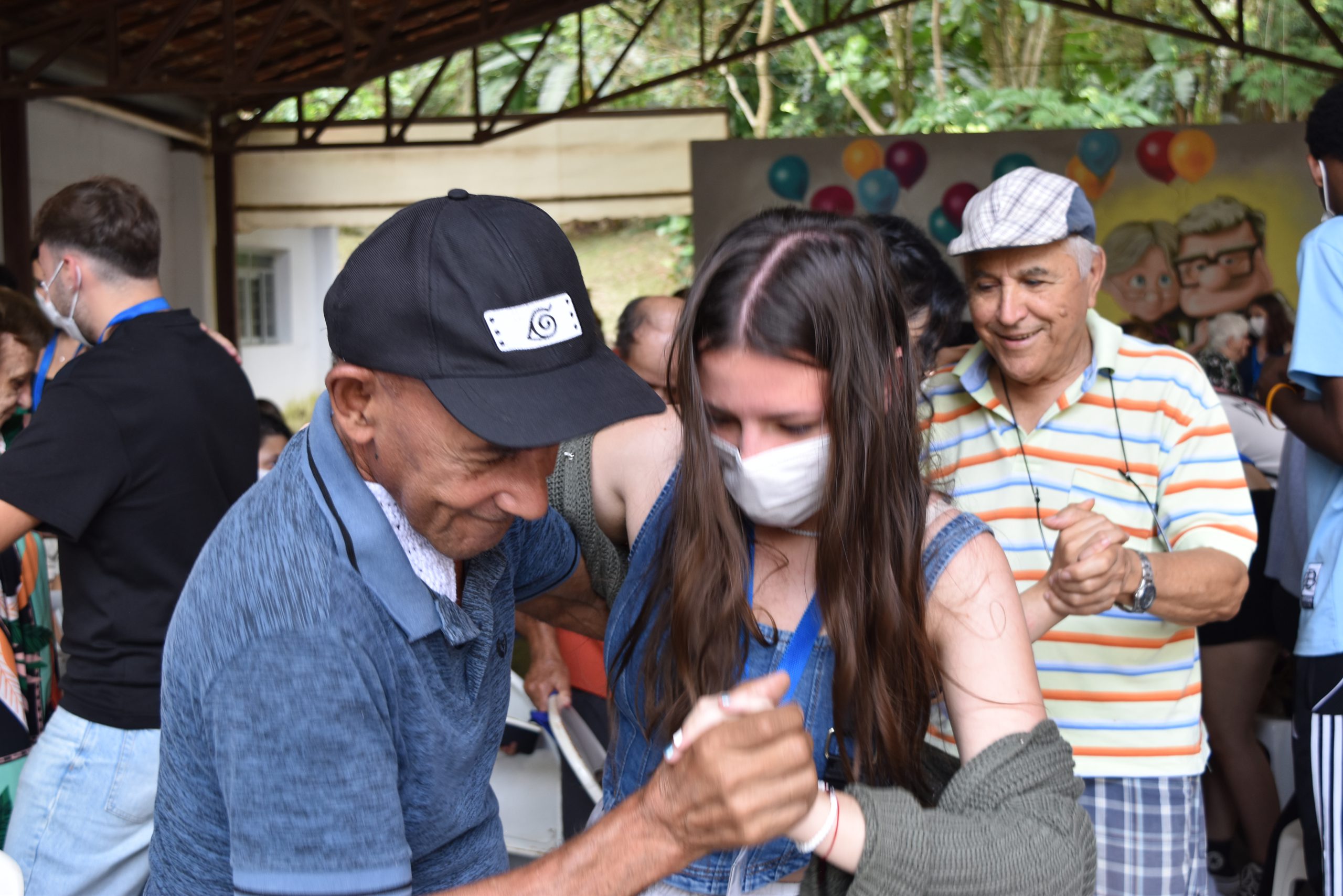
The third day started with a visit to a center that is seen as a ‘kindergarten’ for older people – a home where they can spend the day taking part in entertainment and social activities. The group from the Encounter took part in two activities – first, they were seated together with the older people, chatting, exchanging ideas and painting. Then, they started to dance in a happy and vibrant moment.

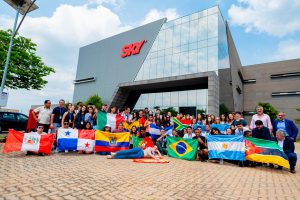
The following stop was at the Sky Broadcasting Center, where the group learned about satellite transmission. They also visited Da Barra Farm, one of the oldest and most important sites of the city, where they joined a Capoeira class – an Afro-Brazilian martial art that includes elements of dance, acrobatics, music and spirituality – followed by a Samba class; in traditional Brazilian style, the day ended with a game of football.

The Encounter saw people speaking mainly in three languages: Portuguese, Spanish and English. Few of the students shared a common language. However, they found ways to engage, as explained by 16-year-old Hannah Duchen, from the ORT-affiliated King David Linksfield school in Johannesburg, South Africa.

She said: “I have met with people who don’t speak the same language as me, and we connect on such a different level. You learn in this country that people want to make peace, and just want to have friendships, and just want to have fun.

“I’ve been inspired to make changes because it taught me that we make our own barriers. This experience has allowed me to be more open-minded and see people for who they truly are and not look at the superficial things – just try to look at a person’s soul.”

The closing ceremony included a tree planting ceremony in honor of the Israeli students who could not attend. The trees will grow at the city halls and at the local Jewish center.

The Rabbi of the Congregação Israelita Paulista (CIP), Ruben Sternschein, was invited to share a few words and said: “The function of humans, from Biblical times, has been to work together and take care of the land. What happened on these days on the Encounter, the conversations between different people, the sharing of strengths and weaknesses, maybe it is exactly what humans should do.”

The ORT students came from countries around the world

During the Encounter, Jose Maria Del Corral had an opportunity to talk to the ORT teachers, sharing the history and the importance of the partnership between ORT and Scholas: “We are not a Catholic event that creates an interfaith dialogue. We are an interfaith event – we were born in this way. It makes it so special. We said to the Pope that we would have at least one annual celebration to work for unity and diversity.”

The ORT students had a life-changing educational experience at the event. Ina Spyrydonnova, a 15-year-old student from the ORT school in Sofia, Bulgaria, said: “Magical is maybe the word. Uniting people from different countries with different perspectives. I learned how to fight for my rights. If you want something to change you need to fight for it.”

The event is a partnership between Scholas Occurientes, World ORT and the Leo Werthein Foundation. Previous encounters took place in Jerusalem, Vatican City, Buenos Aires, Mexico City, and Panama City.

VIEW THE GALLERY

ORT Students Complete Global Citizenship Program and Manifesto

The first year of World ORT’s Global Citizenship curriculum has concluded with a celebratory event for students and their teachers, featuring the launch of a manifesto written by the students.

For the past five months, students have met online to discuss all aspects of Global Citizenship and the curriculum – which was initially introduced to teachers and schools across our network last October.

Training sessions, events and programs have been delivered in a number of countries during the first rollout of the curriculum. These have included teachers taking part in sessions to gain confidence in bringing emotional intelligence into their classrooms, and a series of online events featuring key aspects of Global Citizenship such as water sustainability and the experiences of refugees.

The Global Citizenship program is intended as a recognition of ORT students’ long-term commitment to learning new skills and implementing them to drive the future of Global Citizenship across our network.

They have connected online from their home countries to carry out research and discuss global issues together.

The first World ORT Global Citizenship Manifesto is the outcome – a published document providing a snapshot of ORT students’ concerns, thoughts and ideas around what Global Citizenship means to them.

Eric Schloss, the World ORT Education Project Manager who has overseen the first year of the program, said: “Through amplifying the voices of the global student body, ORT is now able to ensure that the Global Citizenship program will meet the needs and wants of our students in the coming years.

“The UN’s Sustainable Development Goal 4.7 was an international call to educators and educational organizations to provide learners with skills and knowledge that will help promote a culture of peace and non-violence, gender equality and appreciation of cultural diversity as well as learning about Sustainable Development and Human Rights. This program stood as a statement of ORT’s commitment to this just endeavor.”

Student ambassadors met online to complete six hours of training in governance and dialogue techniques to help build consensus. Three ambassadors from each school then conducted surveys among their peers, gathering insight on diverse social and environmental concerns as well as interpersonal issues such as mental health, identity and communicating with others.

Finally, by gathering completed surveys from more than 140 students globally, they were then able to bring their data and knowledge to a series of Youth Forums where they created responses which ultimately formed the manifesto document.

The celebration event on July 6 acknowledged their work and contribution to the future of the program and officially launched the manifesto.

Alex, a student at the ORT No. 134 ‘Dimcho Debelianov’ Jewish School in Sofia, Bulgaria, said: “As a teenager you don’t have a lot of power to do things, so attending a project and being an active part of this makes me feel really nice about myself. I’m doing something really useful.”

Samantha, a student from South Africa, added: “My experience on this project was very fruitful because I got to grow as an individual by socializing with people, which was previously very difficult for me. I’m going to take this as a life lesson.”

The manifesto itself states: “A Global Citizen is an individual who identifies as a member of a global community and who tries to take action to contribute to building the values and conduct of this community. Different people bring different ideas to the table, so we contribute by sharing our differences.

“A Global Citizen is a person who does what is in their power, to stop what is jeopardising our planet so we can live in a fairer world. All of us are Global Citizens, and each one of us can make the world better.”

You can read the Manifesto document here.

ORT’s Audience With Pope Francis Marks Scholas Success

World ORT Chief Program Officer Vladimir Dribinskiy met Pope Francis as part of our ongoing collaboration with the Pontiff’s Scholas Occurrentes Foundation.

To mark the occasion, World ORT planted three trees in the Panama rainforest, ensuring a healthy habitat for rainforest plants and animals.

Our commitment to the Scholas educational interfaith annual event and program has seen dozens of ORT students from around the world meet their peers to discuss issues relating to understanding, tolerance and sustainability. The event is sponsored by, and was introduced to World ORT by, the Leo Werthein Foundation.

It is hoped this year’s event will take place in São Paulo, Brazil, in October.

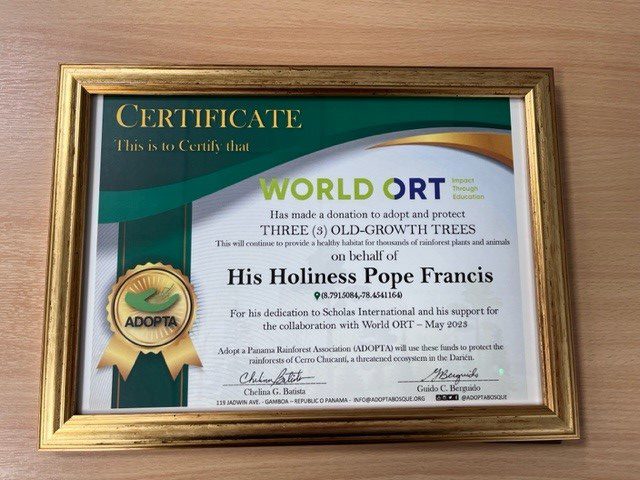
Mr Dribinskiy presented the Pope with a certificate giving the exact geolocation of the planted trees.

Mr Dribinskiy said the audience at the Pontificio Istituto Patristico Augustinianum next to the Vatican was a remarkable opportunity and that Pope Francis had appeared delighted with the donation of the trees.

World ORT’s annual Ecology Summer School takes place in the Panama rainforest and gives students an understanding of environmental and sustainability issues.

Previous Scholas meetings have taken place in Jerusalem, the Vatican, Argentina, Panama and Mexico.

The certificate Vladimir Dribinskiy presented to Pope Francis


Learning from Others Ahead of World Refugee Day

Every year around the Seder table, Jews ask the question ma nishtana, why is this night different? Without giving too much away, the answer is essentially because we are free.

The Exodus story marks the liberation from Egypt of the slaves who then marched with Moses into the wilderness in search of a new beginning. This story of migration, fleeing persecution and creating a new identity, although occurring some 3,000 years ago, holds strong relevance in the current day.

On Pesach we eat maror and dip bitter herbs and recount stories of the Warsaw Ghetto in 1943; and the unfortunate fact is that today we are facing a global crisis of displaced people. In the first months of 2022, the number of people forced to flee war, violence and persecution worldwide surpassed 100 million for the first time according to the United Nations.

More than 100 students from across ORT’s school network – including in Panama, France, Spain, Mexico and Argentina – joined a special online session on April 20, the week after returning to school from the Pesach holidays, to hear three displaced women speak on their experiences of leaving home and arriving in a new country and having to adapt to carve out a new future for themselves.

This event was part of World ORT’s Global Citizenship International Events series. Global Citizenship is centred around the growing need for new skills and attitudes in our rapidly changing world, together with a focus on addressing the issues of our time. A first-hand engagement with the lived refugee experience engaged the students with a wider lens of humanity, nurturing empathy and other humanistic values.

The students heard from two Afghan women: Sadaf who had left six years ago and settled in Greece, and Mehreen, who had only left 18 months ago and who currently resides in Albania. We also heard from Sofia, a young Ukrainian who has made her home in Bulgaria.

After briefly sharing an overview of their experiences leaving their home countries, the students asked questions such as ‘what do you miss about your culture and traditions?’ and ‘have you experienced any form of discrimination?’. These pertinent questions, along with the emotional and inspiring answers from the panel, gave a real depth of insight.

These incredible women have all been beneficiaries of ORT projects, either through schools directly or the International Cooperation (IC) initiatives at the Irida Women’s Center in Thessaloniki or the Tirana Training Center. They spoke of their ambitions for their careers and study and ahead of World Refugee Day in June, we celebrated the courage of these women and felt inspired by their stories and words of wisdom: “Never give up in your life, it’s up to us to build our goals and our future dreams. For example, I have faced a lot of failures in my life, a lot of failures, and this was not the end point. I just stand up again and continue.”

They reminded us to be compassionate and remember that all people are seeking the ability to determine their own future and we should open our hearts, and perhaps the door, like we do for Elijah.

Accelerating Change for World Water Day

The combination of World Poetry Day and World Water Day on consecutive days in mid-March provided the opportunity for the latest event in World ORT’s Global Citizenship Education program.

Bringing together students from across the ORT network, the online session saw the sharing of water-themed poems and presentations.

The theme for this year’s World Water Day event was Accelerating Change. Students joined from countries including Peru, Panama, France, Israel, Lithuania, Brazil and South Africa.

The group learned about the largest river basin in the world – the Amazon river – from students in Brazil; heard about water-borne diseases in the form of poetry from students in Peru; and the process of creating tap water in the Ile-de-France region from students at the Ecole de Travail ORT in Paris, France.

The Lithuanian students introduced us to the 22,000 rivers and mineral springs in the country. Students from Colegio Isaac Rabin in Panama City, along with peers from Israel and South Africa, shared with us the struggles of clean water access and solutions such as rainwater harvesting, desalination and the B.O.B barrier introduced to the Matias Hernandez River in Panama to tackle plastic pollution.

Jorge Arditti, architect and founder of the We Are Water Foundation, shared the great work he has been involved in bringing clean water to communities globally. The event took place at the beginning of the week before the UN Water Conference in New York, where global leaders and experts discussed strategies for tackling the water crisis.

This group of ORT students certainly recognised the importance of water to health, society and nature as a whole, as Joshua from Strasbourg put it in his poem: “Water is our friend…so raise our glasses to our lovely earth!”

To tap into our reservoir of resources from the event, including the recording, please click here.

Ethiopian Jewish Community Workshops Provide Life-Enhancing Skills

A new initiative has been launched to benefit young Ethiopian Jews who do not have the opportunity or community resources to learn basic skills and to experience the modern professional world of work.

ORT is providing these young people with the tools needed for future employment in tech and other skilled industries.

Israel-based World ORT Kadima Mada (WOKM) is designing workshops and providing instructors to facilitate science and technology skills building. The program is part of the World ORT International Cooperation department’s global aid work, in partnership with Struggle to Save Ethiopian Jewry (SSEJ), with support from the Buncher Foundation.

The skills training program will ultimately reach 300 Ethiopian Jewish students aged 14 to 21 in the town of Gondar. The students will learn how to construct their resumes, prepare for job interviews, learn communication skills, and receive an introduction to innovation and entrepreneurship.

“Ethiopia is a beautiful country with kind and welcoming people. The SSEJ learning center is full of young men and women eager to move to Israel and celebrate their Judaism. They are embracing Jewish studies and culture and learning Hebrew while gaining knowledge. I am inspired by the eager young students discussing their future aspirations,” said Dr. Moshe Leiba, WOKM Deputy Director General and Chief Pedagogical Officer, who traveled to Ethiopia with Shlomi Lasri, WOKM Project Manager.

“These skills are necessary for these young people to advance. For those who are able to make Aliyah to Israel, it will make all the difference in their ability to acclimate and succeed in Israel’s high-tech economy,” he added.

WOKM is providing trainers to run the program, both virtual and in-person, while also training local trainers. The workshop will officially start mid-January and will be comprised of two classes of 20 three-hour sessions. Two of the trainers are Ethiopian immigrants based in Israel who will deliver the training remotely in the local language, Amharic. Both these instructors – one male and one female – are currently studying at Israeli universities and serve as role models for the Ethiopian students. A third instructor, trained by WOKM, is based in Gondar.

Approximately 14,000 Jews in Ethiopia live below the international poverty line of $1 per day. Severe malnutrition is rampant and access to adequate medical care and shelter is non-existent. Covid-19 ravaged the population and a civil war has been raging for several years. The community practices traditional Judaism, keeping kosher and celebrating Shabbat and Jewish holidays and many of them speak and understand Hebrew. More than 70 percent have parents, spouses, children or siblings in Israel.

Dan Green, World ORT Director General and CEO, said: “The goal of this program is to give Ethiopian Jews the tools they need to succeed.

“Our ORT mission is to improve lives worldwide through education, training, and technical assistance – just as we have done through our International Cooperation program in 101 countries over the past 62 years.”

Since 2006, World ORT Kadima Mada (WOKM) has affiliated with schools throughout Israel, primarily in socially and economically challenged communities in the country’s geographic periphery.

WOKM incorporates the latest technology and advanced instruction into the schools’ curricula through formal and informal educational programs to level the playing field for thousands of students. WOKM gives them access to high-level STEAM (Science, Technology, Engineering, Art, Math) education and, as a result, countless students go on to study at Israeli universities and serve in elite units in the IDF. Today, many WOKM graduates can be found in Israeli industry, and its vibrant business and tech sectors.

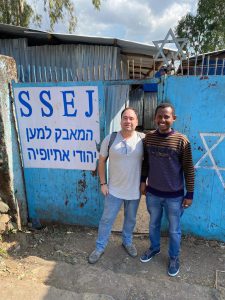
Moshe Leiba in Gondar, Ethiopia

ORT’s International Cooperation (IC) department responds to needs and challenges with a range of development programs, community training initiatives and humanitarian aid missions.

For decades we have helped disadvantaged people in Africa, Eastern Europe, the former Soviet Union, Latin America and Asia, regardless of their religion or ethnicity. Our IC programs are designed to meet local needs and to overcome economic, cultural and linguistic barriers while working with partners on the ground to integrate projects quickly and effectively. We focus on sectors in which ORT has earned a reputation for excellence and impact, including vocational and technical education, workforce development and agriculture.

Since its founding in 2000, SSEJ has assisted tens of thousands of Ethiopian Jews. SSEJ is the main source of humanitarian assistance for the Jewish community in Ethiopia. Its programs include feeding centers, medical care, Jewish and secular education, as well as religious and other communal activities.

Global Citizenship: Recognizing the Challenges of our Times

Global Citizenship can be defined and understood in many ways, as more than a dozen delegates from across ORT’s network have discovered at the official launch of the organization’s Global Citizenship program in Israel.

As the first face-to-face teacher seminar organized by World ORT since the pandemic, it felt fitting to focus on global issues and how tools such as Social and Emotional Learning can help us to understand and empathize with others in difficult conditions.

World ORT’s flagship Kfar Silver Youth Village is an example of Global Citizenship in action and was a perfect location for the four-day gathering.

With a student body comprising many demographics, including migrants to Israel from Ukraine and Ethiopia as well as Israeli-born students coming from challenging backgrounds, the village has found a harmony and culture which nurtures growth and understanding.

Participants were warmly welcomed by Amos Gofer, CEO of Kfar Silver, and his staff team and the village’s Young Ambassadors at the beginning of the week.

Global Citizenship Education (GCE) embodies a new approach to education, which aims to meet the challenges of our times. Many models of GCE recognize a need for transformation within the education system to address the fact that our world is more globally connected than ever.

ORT identifies that the seeds of the solutions to global problems lie in empowering teachers and introducing initiatives which nurture and enable the potential of young people. As one of World ORT’s three pillars, this is the hope for the Global Citizenship program.

ORT delegates arrived in Israel from nearly all corners of the network, including Latin American representatives from Mexico, Argentina, Colombia, Costa Rica and Brazil; European countries including the Czech Republic, Bulgaria, France and Italy; ORT South Africa; and of course from World ORT Kadima Mada in Israel.

The plan was to introduce the teachers to the Global Citizenship concept and then explain the World ORT program over the week while getting a taste of Israel’s unique culture and an insight into social issues. There were also sessions for reflecting on ideas such as identity, sustainability and emotional intelligence.

Participants heard from experts including Professor Miri Yemini, a comparative education lecturer from the University of Tel Aviv; Dyonna Ginsburg, CEO of Olam, an international network of Jewish and Israeli NGOs and aid organizations; and Sharon Carmel, an advisor and facilitator of Non-Violent Communication.

Between these sessions, Eric Schloss and Daniel Tysman from World ORT’s Education Department unfolded a narrative of how ORT would bring students from the network together to discuss perspectives on global issues.

The Education Department has created a pathway for schools which culminates with a series of online International Forums. Along the way students have opportunities to develop competencies and practice skills which are conducive to building empathic, collaborative relationships. The goal is to create a World ORT Global Citizenship Constitution which represents the core values and attitudes of students from across the network, representing the diversity of students across our schools and which can be a foundation for the Global Citizenship program for years to come. To recognize and work through the complexity of so many different perspectives and lived experiences is no easy task.

The group spent a day in Sderot, the Israeli town most targeted by rockets from Gaza. They were welcomed by social worker and psychotherapist Ayelet Shmuel, director of the Sderot Resilience Centre. Participants visited schools in the town to understand how Social and Emotional Learning (SEL) is used to address the impacts of living in a conflict zone. That evening, the group visited a Bedouin village and were confronted with some of the complexities of the modern state, including land rights and citizenship of Arab Israelis.

These types of difficult issues and having the ability to engage in dialogue with those who think differently about them, are integral aspects of Global Citizenship and the values which a Global Citizen can aspire to. Although Israel is unique, these are issues which can be recognized in some form all over the world.

The experience of learning about each other’s cultures and schools as well as the diversity of Israel was well received by the teachers and they were enthusiastic to be the pioneers of the World ORT Global Citizenship program in the new year.

The peaceful, just and sustainable world of the future is dependent on young people being empowered and trusted to find new ways forward, where perhaps previous generations have struggled. Education has the potential to help shift perspective from seeing just our own experience to understand that of others and see just how interconnected our challenges are.

Judith, a participant from Olami ORT school in Mexico said: “I am really grateful for the experience and to meet so many intelligent and committed people. I’m convinced now that it’s everyone’s responsibility to understand what it means to be a global citizen and to put that into action.”

VIEW THE PHOTO GALLERY