‘Everyone in Israel is suffering from trauma after October 7’

This article first appeared on JNS

“Everyone in Israel is suffering from trauma — it doesn’t matter if they weren’t present at an October 7 incident, lost a member of their family or were evacuated,” says Moshe Leiba, chief pedagogical officer and deputy director general of World ORT Kadima Mada (WOKM).

“Even those who weren’t affected directly are traumatized … we are seeing students and teachers who are severely traumatized.

“There are cycles of grief; we are, unfortunately, a state in trauma. Even if the war would stop today, it will take years to rebuild ourselves.”

The Hamas-led terrorist attacks in southern Israel on October 7, 2023, followed the distress and disruption of the multi-year Covid pandemic. Students were starting to return to school and a sense of normality when Hamas attacked and sent them into another crisis, Leiba says.

“Children had a lot of mental health issues from Covid, from the lack of social interaction and structure, and we were already talking about how it would take years to bridge the gap,” he explains. “Now, some of those children have been evacuated for a year and a half, and the issues continue with the trauma of October 7.”

WOKM Educational Psychologist and Sports Consultant Royi Yablochnik, who was seconded to World ORT’s Kfar Silver Youth Village to provide much-needed psychological support, credits World ORT with helping staff and students to access it.

Animal therapy at Kfar Silver Youth Village

“It was very important that we were able to open up this support for everyone who wanted to see a therapist and not let them wait weeks or even months,” he stresses. “More people are now coming to therapy because they have time to treat themselves and are no longer in survival mode.

“We need to give them the opportunity to see psychologists — the connection between a patient and a therapist can help to prevent post-traumatic stress disorder.”

He says that his main goal after the attacks was to give people a sense of control and the opportunity to “rebuild”.

Another pressing issue was that many staff and students were evacuated from their homes, especially in Israel’s south. While around 98% of people have returned to the WOKM schools and programs in the south, there is still displacement in the north. Only 40% of students returned when northern schools reopened in March.

Support provided by World ORT’s campaign and global supporters includes providing students’ families with money for food, in one case in the north for a family where a student’s mother was ill with cancer and the father had lost his job.

At Kfar Silver Youth Village, only eight miles from the Gaza border, scholarships and stipends were provided not only to students and their families but to teachers and other staff, as well as therapeutic and psychological support.

Yablochnik says giving people the strength to “get used to this routine, of life in war” was crucial.
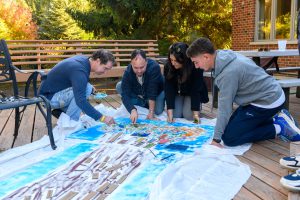
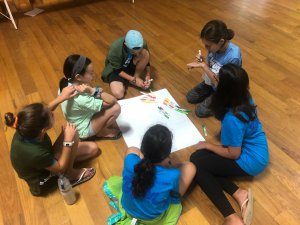
Moshe Leiba (second left) at an art therapy session with students on a respite trip to Chicago

WOKM provided mentoring and organized activities in evacuation centers, hotels and hospitals where people had been displaced.

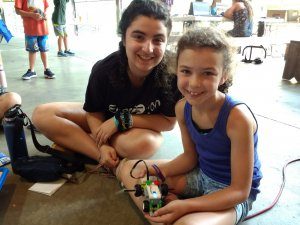
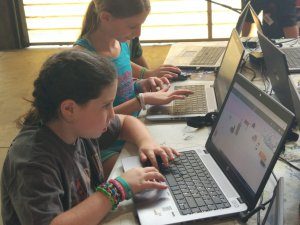
“We did a lot to try to alleviate stress,” Leiba says. “Some of our staff went under fire in bomb shelters to work with students, doing robotics, DIY and photography, and we’re still doing that.”

Other resilience and confidence-building programs have included Krav Maga self-defense sessions with techniques on how to control mind, body and energy. Meditation and mindfulness, which are included in the classes, have helped students remain calmer during lessons.

Another program both experts believe has been supremely beneficial to students is the respite trips that have taken place in the United Kingdom, the United States and Mexico.

“It’s something ORT did that was very powerful; it gave students a break from all the stress in Israel, and it was amazing for them to see the love from the community all over the world,” says Yablochnik. “There was a feeling that the Diaspora is looking out for us and that we all have the same goal.”

Leiba adds: “The bonds created between the host families and the kids gave the students a lot of strength. In many cases, they are still in touch, even after a year. The ORT host families felt they were doing something meaningful, and it connected them much more to the organization.”

One consequence of the respite trips was that some students who had not previously wanted to pursue psychological support asked for it upon their return. “They understood the importance of it afterwards,” he said. “For the others, we try to find alternative solutions, for example, photo, drama and animal therapy.”
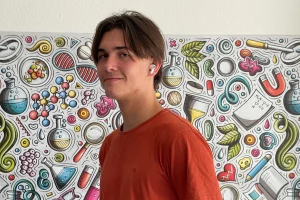
These Ukrainian teenagers sought refuge from war in Israel. Then they were caught up in the horrors of Hamas’ attack

This article first appeared in CNN
Ashkelon, Israel — CNN — It was supposed to be a safe haven – a new life for those seeking refuge from the turbulence of war.

But when tens of thousands of Ukrainians fled to Israel in the wake of Russia’s invasion, they had no idea of what the future would hold.

With men aged 18 to 60 forbidden to leave Ukraine, the refugees were mostly women, children and the elderly. Among them, four courageous teenagers who arrived alone in Israel to start a new life as a result of Moscow’s assault on their homeland on February 24, 2022.

Little more than a year and a half later, these young people found themselves immersed in another conflict, as they study at a boarding school just 8 miles from Gaza.

“The day before was very peaceful,” recalled Artem Karpin, 18, of Hamas’ attack on Israel on October 7. “I remember thinking I wasn’t really ready with my homework and wondering how to postpone my deadlines.”

Karpin lives and studies at Kfar Silver, a youth village near Ashkelon, close to where Hamas militants infiltrated the border that Saturday morning. He is one of about 40 Ukrainian refugees to enrol there since Russia invaded his country.

Artem Karpin was visiting family in Israel when Russia invaded Ukraine. His family insisted he remain there.

Run by the global education charity World ORT, the “village” is effectively a sprawling complex for 1,090 children from challenging backgrounds – including 250 boarders.

Originally from the southwestern city of Odesa, Karpin had been visiting relatives in Israel when Russia invaded Ukraine. His father gave him no choice but to stay put.

“I started crying when I began to understand that I’m not going back,” he told CNN at Kfar Silver. “I felt betrayed. I didn’t think it was a wise decision to leave me here.”

Nearly 2,000 miles from his parents, Karpin, then 16, enrolled at Kfar Silver, where he soon began to learn the language, make friends and settle in. That was until life was upended again on October 7.

“That morning we all ran from the dorms to the shelter in the school,” he said. “I was scared but not terrified. I was trying to talk it all through rationally and it really helped.”

Karpin was one of 63 of pupils on site that day, as was 18-year-old Michael Reider.

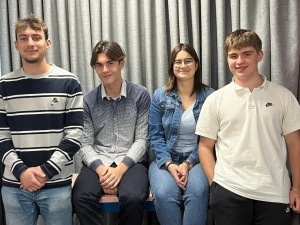
These four teenagers all moved from wartorn Ukraine to Kfar Silver near Ashkelon in Israel. From left: Michael Reider, Artem Karpin, Maria and Sviatoslav Kulyk.

Originally from Kyiv, Reider arrived in Israel in March 2022 following a gruelling journey from his homeland to Poland, where he spent a week on his own before flying out.

On that “black Shabbat” of October 7, he said: “I woke up and there were a lot of sirens and rockets were flying.

“I had already experienced one invasion and now this was a second one. I don’t know how to explain it – I wasn’t really afraid. I felt kind of angry and like I had the energy to fight.”

Pupils and staff remained in the shelter for hours as the unprecedented terror raged around them.

Amos Gofer, who served in the IDF for 25 years before becoming chief executive of Kfar Silver, told CNN: “During my military service I spent time in Lebanon, Gaza, occupied territories. I saw some stuff but October 7 was the hardest day of my professional life.

“We were terrified. We knew very early that the situation was very bad, that there were a lot of terrorists.”

‘Thousands of rockets’

Friday had marked the end of a week-long religious holiday, so fortunately very few pupils were at school, said Gofer. Most of the Ukrainian students, however, had nowhere else to be.

“I was sure the terrorists were going to come here to kill us,” said Gofer, who keeps the remains of a rocket which exploded on the school grounds on his desk.

“I had three people with personal pistols, which was nothing compared to the heavy ammunition the terrorists had.

“We saw no helicopters, no police, no military – I still don’t understand why it took so long,” said Gofer, referring to widespread reports on October 7 that the army and security forces took hours to react to the incursions.

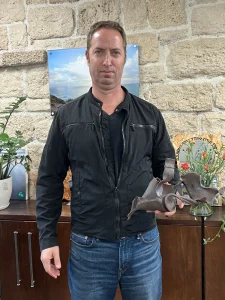
Amos Gofer, CEO of the Kfar Silver youth village, poses with the gnarled remnants of a Hamas rocket which landed near to the school.

Gofer told CNN that “thousands of rockets” flew over the village, while fires broke out everywhere around them.

With no response to his repeated calls to the army and emergency services, who were dealing with ongoing attacks in multiple locations, Gofer finally called a bus company manager he knew.

“He told me none of his bus drivers were willing to come… everyone was terrified.”

Two drivers from the bus company eventually volunteered to evacuate the children to another village further north, he added. “They told me if they’re not out of here in two, three minutes they would go without the students.”

Karpin recalled: “We had several minutes to pack our clothes and run for the buses. I got the most essential stuff and that’s it. In an hour or two we were in Netanya.”

Four days later, Karpin’s parents, back in Ukraine, insisted that he leave Israel with other relatives for Europe.

“After three weeks I started to feel that I wanted to return (to Israel),” he said of his time in Greece and Germany. “I missed my studies and my friends. It was getting a little safer in Israel, so I convinced my family I needed to get back.”

‘I was scared’

In common with some other foreign boarders, 17-year-old Maria, who asked not to give her surname for privacy reasons, was staying with a nearby “host family” because of the religious holiday when Hamas launched its assault on October 7.

“At six in the morning we were all running to the shelter and you could hear sirens,” she said.

Originally from the eastern Ukrainian city of Kharkiv, Maria and her younger brother had moved to their father’s home in Kyiv following the Russian invasion. Eventually the two siblings left the country via Moldova and flew to Israel.

“When war broke out in Ukraine it was like life fell apart and this time it was very similar – I had flashbacks,” she said. “I was scared but also thought if I tried to distance myself as much as possible everything would be OK.”

Israel’s Iron Dome anti-missile system intercepts rockets launched from the Gaza Strip, as seen from Ashkelon in southern Israel October 8, 2023.

She remained with the family, who live in Ashkelon, for several days before heading north to join the evacuees, including her brother. There they remained until last month when they returned to the school.

“My mum was worried about us,” she said, adding that their mother suggested they return home to Ukraine.

“I told myself I could go back but that I’d be going back to war and I couldn’t possibly know if it’s safer. At the same time, I didn’t want to leave Israel. I thought ‘do I need to flee again to start life again once more?’”

After lengthy family discussions, the siblings decided to stay.

“In some ways I’d rather be here,” said Maria. “I just wish for my family to be brought together again in peace.”

Fellow Ukrainian Sviatoslave Kulyk, 17, told CNN he had “not been afraid at all” about leaving his family for Israel back in 2022.

“I understood that it was better to live in a country with no war,” he said.

That all changed when he woke up at his friend’s house in Ashkelon on October 7.

“I had flashbacks to Ukraine, especially when we watched TV about what was happening,” said Kulyk, who told CNN he had witnessed Russian forces roll into his street from his home in Kharkiv.

“My mum was really afraid of me being in Ashkelon but I was trying to explain that I had a bomb shelter here,” he said, adding that Ukrainian homes are not equipped with so-called safe rooms. All Israeli homes built after 1993 must have such a shelter, designed to protect residents from rocket attacks.

Pupils at the Kfar Silver “youth village” near Ashkelon have come under fire from Hamas rocket attacks. Among them are a number of Ukrainian teenagers who fled their homeland for refuge in Israel.

Ukrainian students travel to Bulgaria for digital summer school

This article first appeared in Jewish News Syndicate.

Ukrainian students travel to Bulgaria for digital summer school

The two-week program, taught by skilled professionals, deepens students’ experience in photography, video and audio production.

Three Ukrainian teens took part in a summer school in Bulgaria after World ORT facilitated their departure from the war-affected country to join peers for the chance to learn digital skills.

It took more than 24 hours as they crossed thousands of kilometers by road and then rail from their Ukrainian home cities—first across the border to Poland and then by plane to Sofia.


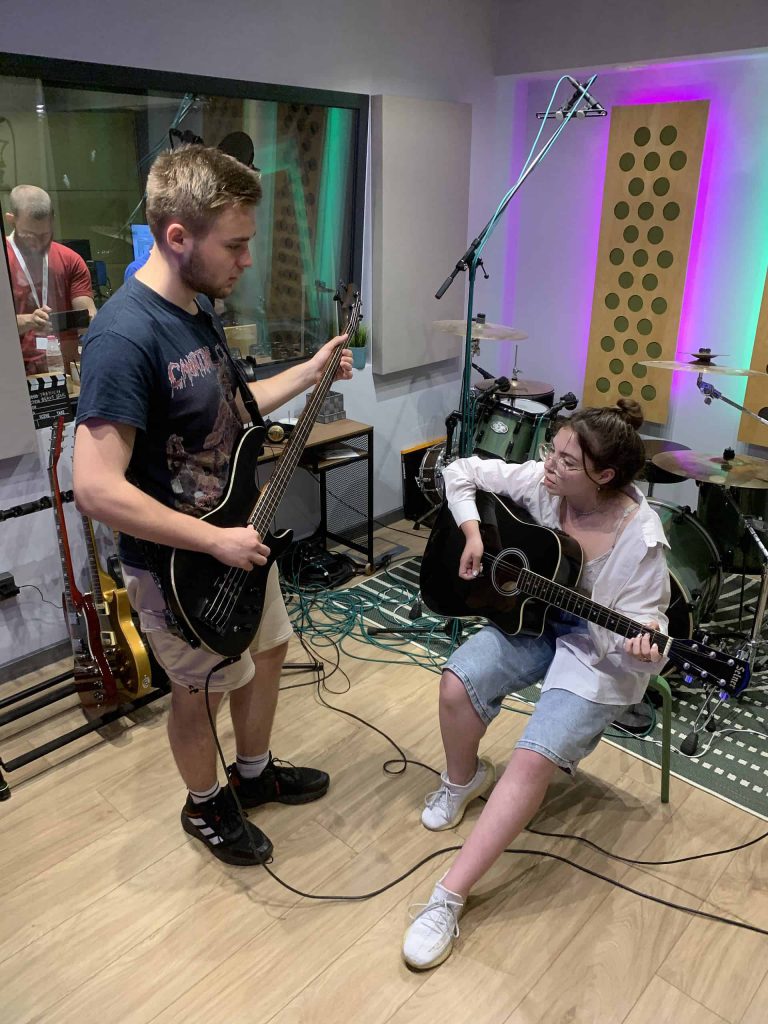
Polina Tymofieieva, 16, records a song she wrote about Ukraine, August 2023. Credit: World ORT.

Natan Hen from Bila Tserkva in the Kyiv region and Ihor Belinskiy from an ORT school in Kyiv, both 15, as well as 16-year-old Polina Tymofieieva, who traveled furthest from the ORT school in Zaporizhzhia, participated in the World ORT Digital Skills Academy.

The two-week program, taught by skilled professionals, deepens students’ experience in photography, video and audio production. Natan studied video editing; Polina took an audio production course; and Ihor focused on photography skills.

Anna Chumakova, an ORT Ukraine staff member based in Kyiv, joined the trio on the journey and at the camp. She said that “the kids were so excited to take part. Combining the opportunity to have a distraction from life at home and the constant air raids with the chance to learn so much and have this priceless experience was really an amazing thing.”

During the camp, Polina played guitar and recorded a Ukrainian song about hope and the future in a professional-standard studio. A fellow student attending the summer school from Lithuania filmed the experience and created a short video for social media.

“The summer school was an opportunity for me to distract myself from the reality of life in Ukraine and to gain a lot of new knowledge to help build my future career,” she said. “We worked so enthusiastically on our projects and attained a really high level.”

“The camp had an atmosphere of peace, mutual support and friendship. It was a place where dreams could come true. I had always dreamed of recording a song in a professional studio. I was so pleased we recorded a Ukrainian song; it was very important for me. I have a lot of precious memories from this summer school.”

Ihor’s work featured experimental approaches to the use of light in photography and images of his fellow camp participants.

 “Thank you to the new friends and teachers who were with us all the time,” he said. “I had a lot of fun, and I’ll remember this—the memories will stay in my heart.”


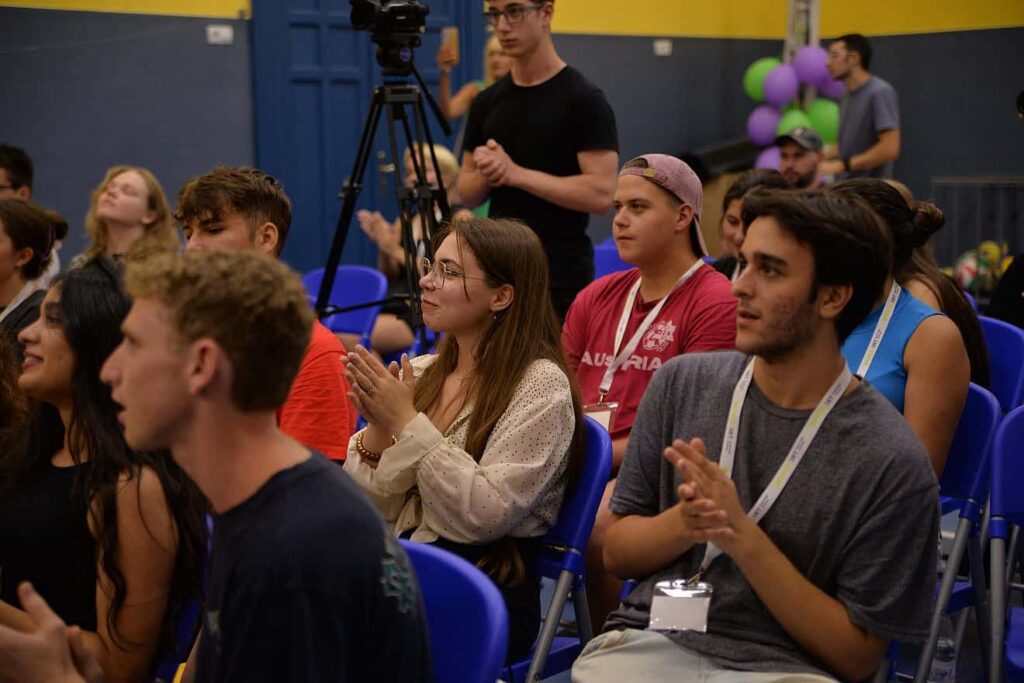
Teens from Ukraine with others at a summer school in Bulgaria that focused on photography, video and audio production. Credit: World ORT.

An ornate desk, family history and the Jewish past

This article first appeared in Washington Post. You can read it on their site here, or below: 

My mother’s desk connected me with our shared heritage

In the mid-1920s, a group of Jewish woodworking students in Warsaw made two elaborate desks as centerpieces of traveling exhibits to show off their skills and seek more funding. The Jewish community in Poland, a nation newly independent in the wake of World War I, was extremely poor, so a group called the Organization for Rehabilitation Through Training (ORT) had opened technical schools in Warsaw (among other programs) to teach skilled trades to Polish Jews. Although ORT is a European organization, much of its funding came from prosperous American Jewish communities. They shipped one desk, part of a “suite for a man’s study,” to ORT headquarters in Berlin, and it is now in London, where the organization is currently based.

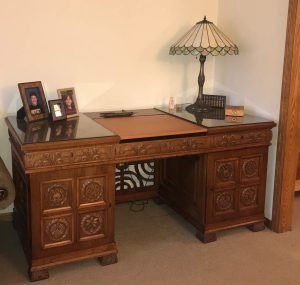
A desk made by Jewish woodworking students in Warsaw in the mid-1920s. It is now in the home of David Perry. (David Perry)

They sent the other one on tour to New York. And on a cold day in late March, two long-haired guys from Nebraska carried that second desk from their U-Haul through my front door and installed it in my living room.

It’s new to my house, but it’s always been part of my life, a landmark in my mental map of all the homes I lived in as a kid. When I was 7 or 8 and I wanted to pretend I was in some mysterious castle or wizard’s cave, especially if the winter meant I was stuck inside, I’d crawl under what we always called “the Belle desk.” It’s a grand wooden contraption, with intricate carvings of scrolls, grapevines and for some reason palm trees, a modesty screen (so you can’t see legs from the other side) shaped somewhat like a menorah in the middle, and a center drawer full of foreign coins, letter openers and other treasures. My mom and dad used the desk to handle the household bills. When my sister and I were young, my mother told me later, she would sit at the desk and cry as she tried to balance the checkbook. It was only after Mom died in 2018 that its contents became our generation’s business, a place to store bills and a checkbook, to build a support structure to preserve Dad’s independence for as long as possible.

How bad analogies undermine our understanding of history

In the 1930s, ORT ran schools across Poland, but its furniture-making program was based in Warsaw. The ORT website has a picture of a cabinet that looks a lot like our desk, with eight wood panels identical to the ones I’d run my fingers along as a child, as well as an English-language flyer announcing the display of furniture in New York and seeking funding. Of course, the story of that era of Polish Judaism has a tragic ending. After the rise of Adolf Hitler, ORT continued to try to ameliorate conditions for Jews in the Warsaw Ghetto, funding a garment factory to make clothes for the inhabitants and operating vocational schools and training courses. In the 1960s a survivor, Rachel Gurman, recounted her time in the workshops, and how excited she and her fellows were that they could make a living during such hardship and terror. She described the nearsighted director, Joseph Jaszunski, who, “exhausted and depressed, would arrive at his office early each morning. … Sometimes he arrived with broken glasses, his face covered with blood. Because of his nearsightedness, he would not notice a German coming his way and so would not leave the pavement or take off his hat.” Jaszunski and his family were deported to the Treblinka death camp in January 1943, where they all died, but the ORT programs continued. Not long after, the Nazis decided to deport all the remaining Jews in the ghetto to the camps, and the residents fought back. Few survived.

As a historian, I’ve spent lots of time teaching and learning about the horrors of the past, but the Holocaust has never been specifically part of my story. My Jewish ancestors came to America in the late 19th century, the Ashkenazi branch fleeing pogroms in Lithuania and the Sephardim fleeing poverty in Holland. But the family history of this desk and the story of its origins have merged, somehow, with the recent era of personal tragedy. My mom died in 2018. I spent my last days with her doing the final edits of her book about, as she writes, “the story of the women who attended my grandmother’s [Belle’s] funeral.” It’s about the women of New York who fought for suffrage, then found ways — against great opposition — to move into political life and urban administration. Working on it, literally at her deathbed, I found myself drawn into the early-20th-century history of my family, of which this desk is a part.

A desk made by Jewish woodworking students in Warsaw in the mid-1920s, seen here in the home of David Perry’s mother. (Elisabeth Perry)

My dad died this January; he had Alzheimer’s, and he fell just before New Year’s and went to sleep and never woke up. It takes months, though, to handle all the things, all the stuff, that death forces on us. Each object opens a new wound that scabs over slowly, if all, waiting for the next trigger. It was on Mom’s birthday at the end of March, just by chance, that movers arrived with some of the things my siblings and I had agreed would go to me. So now the desk sits in my house, uncomfortably wedged in a corner next to a small couch.

Can you call yourself an orphan at nearly 50? My parents are gone now, and the weight of keeping memories falls more heavily on my brother, my sister and me. To some extent, this is what it means to grow older, to be left without your elders. It’s easy to feel adrift in time, and so I return to the desk. I put my kids’ pictures on it. I tried to revise this essay sitting at it but fled to the kitchen table instead. I left a medical bill sitting on its surface, a promise to return later.

By David Perry

David Perry is a journalist and senior academic adviser to the history department at the University of Minnesota. He is the co-author of “The Bright Ages: A New History of Medieval Europe.”

‘Education for Life’: World ORT head Dan Green describes priorities, challenges of past two years

This article first appeared in JNS. You can read it on their site here, or below: 

He explains the idea of “repairing our nation,” focusing on the strengthening and flourishing of Jewish communities, and ensuring that students understand who they are as Jews.

 After spending a little more than a week in the United States this month, Dan Green, director general and CEO of World ORT, reflected on his visit and the changes since his last trip before the onset of the coronavirus pandemic.

Q: This was your first visit to the United States since taking on the top leadership position at ORT. How was this visit different?

A: The world changed for everyone over the past two years, and at the same time, ORT’s leadership changed as part of a restructure. Prior to taking the position of director general, I served as the CEO and so was very familiar with the inside workings of our organization, which made it easier to transition into this new role.

However, facing a global pandemic that impacted our entire network in places near and far was a challenge I could not have imagined. As I have been more able to meet in person with constituents in the United Kingdom and during my recent visit to the United States, I can’t help but think that while everything is different, one thing has not changed: ORT supporters, friends and colleagues are as committed as ever to supporting our goals of providing the best education possible to our more than 100,000 students.

Q: Why do you think ORT is thriving today?

A: ORT was founded in 1880 in St. Petersburg to sustain the Russian Jewish community during a time of pogroms and poverty by providing vocational training for practical work. During Communist rule, ORT activities ceased in Russia. In the early 1990s, ORT returned to the former Soviet Union (FSU), and since then, our presence has grown to 16 schools in seven countries. As a result, we are having a huge impact on the ground revitalizing Jewish life.

We also have a strong footprint in Latin America. Our school in Buenos Aires is the largest Jewish school in the Diaspora with 10,000 students, and they have plans to expand student enrollment to 11,000. The economic situation across Latin America is very difficult, and the impact of the pandemic has really taken a financial toll there. One thing that warms my heart is that we have been able to step up and support schools and communities at this time—just as we always have. Although the needs have changed over 141 years, our response has not.

Q: What is the main focus of ORT’s work?

A: One of the pillars of ORT is “Education for Life.” From our London office, we plan programs and activities, and also provide professional development and leadership training to our teachers with the latest advances in STEM education. As the world becomes increasingly dependent on technology, the demand for engineers and skilled technicians is growing. Israel, in particular, is known for its successful high-tech industry, and yet there is a shortage of skilled labor.

This is where World ORT Kadima Mada comes in and begins the educational process with really young students, teaching them subjects like robotics and coding. We are opening new possibilities for these students, who mostly come from challenging socio-economic circumstances. The result is a win-win for both the tech sector and the students, who can look forward to employment and meaningful lives.

We are also uniquely positioned to bring students together—usually in person and now virtually—from across our network, which spans more than 30 countries. The cross-fertilization of ideas and meetings with students and teachers enhance their educational journey. An important area that we have prioritized during this time of uncertainty is our attention to the mental health and well-being of our students and teachers across the network. This is a key concern that our staff has been addressing through teacher training and forums that deal specifically with this issue.

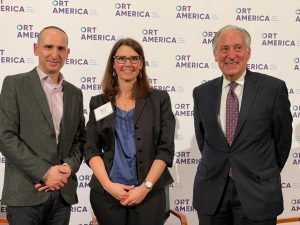
From left: WORLD ORT director general and CEO Dan Green; president and CEO of ORT America Barbara Birch; and Eric Fingerhut president and CEO of the Jewish Federations of North America, January 2022. Credit: World ORT

Q: How does ORT strengthen Jewish Identity?

A: The late great Rabbi Lord Jonathan Sacks said something very profound in 2013, just as he was finishing his time as chief rabbi in the United Kingdom. He said there were two powerful movements in Jewish life at that time—segregation and assimilation—and that Jews were either engaging in the world at the cost of disengaging from Judaism or engaging with Judaism at the cost of disengaging from the world. I think that sort of clarion call was an attempt to strengthen and promote a Judaism that can engage with the world today. For global Jewry today, the role models or teachers that we need are those who can work in the modern world and simultaneously inspire young Jewish people with a love of Yiddishkeit.

We’re at a crossroads, and we don’t want people to go down a path of segregation. We don’t want people to go down the path of assimilation. There’s a third way; it’s striking a balance for people in a very open, pluralistic, inclusive environment. ORT provides that balance by giving people the tools to succeed in the real world, but also understand who they are as confident, engaged Jews.

Q: How can we combat anti-Semitism?

A: One of the key values of ORT is something called tikkun am, which is a counterpoint to the better-known tikkun olam, “repairing the world,” also one of our values. Tikkun am, “repairing our nation,” is focused on the strengthening and flourishing of Jewish communities, and ensuring our students understand who they are as Jews.

We have moved this to the forefront and extended our offerings in terms of the Jewish experience. Many young people embrace tikkun olam; this is certainly the case for many young liberal Jews in America as they increasingly engage with issues around environmental causes and diversity. We want our students to be committed to the Hebrew language, Jewish culture, Israel and Jewish practices as well. Because a concern of mine is that tikkun olam without tikkun am is a potential pathway towards assimilation.

So we are fusing those two values for our organization. And the curriculum that we’re now implementing is designed to strengthen the Jewish learning and experience in all our schools.

Q: What are you most proud of?

A: One of the things I’m probably proudest of is how our network continues to grow. Just in the last few years, Jewish community schools in Madrid and Barcelona in Spain, and in Bogota and Singapore, and soon, hopefully in Costa Rica, have knocked on our door and said: “We want to join you to be part of this global Jewish network.”

For many communities, certainly those perhaps a little bit more isolated, smaller communities really want to reach out and be part of a much wider Jewish family, and that’s something that we offer. I am also proud of our students who are finding their place in their communities. Starting at a very young age, we have kindled that spark of Judaism again. What we see by the time they leave our schools is a stronger Jewish identity and much deeper engagement with their religion and with their heritage, and hopefully, a sense and purpose of wanting to give back and be part of something. In fact, many of our students, as well as alumni, serve as volunteers, communal leaders, teachers of directors of our programs across the network. It is encouraging to see how they want to give back and feel part of that Jewish community.


Barbara Birch: ‘Education Must Address Chasm Between Technology and Moral Guidance’

This article first appeared in eJewish Philanthropy. You can read it on their site here, or below: 

The recent congressional hearings of Mark Zuckerberg and Jack Dorsey put the chief executives of Facebook and Twitter in the hot seat, answering questions on their procedures for moderating content, labeling posts and tweets, and their general responsibility for the use of the platforms by extreme voices on either side of the political spectrum.

Social media is one of the great innovations of our time, changing how we communicate and share ideas in the public square. Yet it has led to enormous ethical challenges. It is certainly not the first time that technology has led to controversy, nor will it be the last.

In an environment of constant innovation, there is also a constant threat of a growing chasm between technological advancement and moral guidance. The speed at which innovation happens, and our eagerness to benefit from its positive impact, clouds our ability to evaluate the potential downfalls ahead. When Zuckerberg sat in his dorm creating Facebook, he could never have imagined the global phenomenon it would become, let alone how it would transform our ability to share views and affect elections worldwide.

We live in an age in which we are constantly encouraging innovation in order to do the most good. Yet it must be paired with a commitment to being good global citizens, balancing economic growth and the welfare of society and the environment, and respecting the rights of others. The concept of Tikkun Olam – repairing the world – has always been a pillar of Jewish life, a moral imperative embedded in Jewish education. Today, educators must consider how we are addressing social responsibility on an international level, because innovation is no longer limited to just a handful of countries.

The United States is home to Silicon Valley and giants of technological advancement, from NASA to Facebook and tens of thousands of boutique developers. Similarly, Israel’s tech achievements and start-up mindset of the past 20 years are impressive. But look now at the countries with some of the highest levels of technological expertise and you will find new names: Estonia, which has invested hugely in national digital infrastructure; Singapore, renowned as a ‘Smart Nation’; the Netherlands, a global frontrunner for digital skills.

There are few global education networks that can set a standard of social responsibility across geographic boundaries. ORT is one of them. ORT is the world’s largest Jewish education network, offering a first-rate STEM education to students in more than 30 countries, including those mentioned above, many of whom would not otherwise have access to the advanced level of science and technology ORT offers. At the same time, every ORT school and educational program embeds the core Jewish values of doing good in the world and teaches these alongside the advanced subjects needed in today’s global marketplace.

Take, for example, ORT alumnus Mateo Nicolas Salvatto, a graduate of the ORT school in Buenos Aires, Argentina. Mateo developed a free app – Hablalo! – which turns text into voice and vice versa to assist people with communication disabilities. The app is used by more than 100,000 people in 53 countries. Mateo credits his use of tech as a social equalizer to ORT’s teaching about social responsibility.

Now in its 140th year, ORT is taking this responsibility, and its unique worldview that crosses continents and communities, seriously. As it embarks on a new strategic direction, ORT plans to develop curricula, which will address vital issues of global citizenship, including giving students the tools to address gender inequity, climate change and other issues that define the world in which we live.

Across the former Soviet Union, Latin America and Israel, ORT students are forging ahead to become the innovators and developers of the future – just as Mateo has. Our network breaks out of geographic silos to provide a platform for collaboration across dozens of countries, sharing knowledge and uniting students and teachers with Jewish and non-Jewish peers around the world. ORT plans to maximize this cross-network collaboration by promoting its experts and sharing educational methods so that each national operation will be able to learn from the others. Working together will also ensure that all learning throughout the ORT network is based in a foundation of core Jewish values.

For ORT, that is what the moral imperative looks like. That is what a global institution, especially one that emphasizes science, technology and innovation, must do to lead in the 21st Century.

Barbara Birch is President and CEO of ORT America

Conrad Giles: ‘Why I’m sticking with World ORT’

This article first appeared in the Detroit Jewish News. You can read it on their site here, or below:

I have been privileged to be involved in Jewish communal life since the early 1960s. I am also fortunate to have lots of choices in life. I could, for example, spend a lot more time reading my volume on Churchill rather than thinking about what is on the agenda for our next Board of Trustees meeting.

So why am I signing up for a second four-year term as president of World ORT, the global education network driven by Jewish values?

Partly because this has been a remarkable period in the history of our organization — due to the COVID-19 pandemic. And also because as I reflect on the challenges of my first term and acknowledge that there have been many, I see that we have met them. We will continue to meet them, even though the future has a rather fuzzy look to it right now.

ORT reaches more than 300,000 beneficiaries in over 30 countries every year. Our teachers are leading classes every day for students in countries as diverse as Mexico and Kyrgyzstan, Latvia and South Africa.

For 140 years since its foundation in St. Petersburg, Russia, in 1880, ORT has transformed lives through training and education. While we once focused on teaching 19th-century Russian Jews essential trades like tailoring or ironmongery, we have evolved to provide 21st century skills in STEM subjects and innovative fields such as robotics and artificial intelligence.

Using ground-breaking technology is second nature to us. This pandemic’s demand that learning take place off-site gave ORT schools a headstart in March. Our teachers and principals were able to quickly adapt their curriculum to ensure every student could continue their education from home as soon as possible when lockdowns were enforced.

In the future, we will be able to expand this level of expertise, but as great a challenge as any over the next four years will be our ability to grow our resources to support our activities globally. ORT’s funding comes in large part from individuals living in the United States, Canada, the UK and Switzerland. Quite simply, despite the public support currently available, we would not be able to function without these supporters.

The education provided by ORT schools is exceptional. It changes lives. On a trip to one of our high schools in Kiev, Ukraine, I met a 17-year-old girl. I always ask our students, “What are you going to do in life?” This girl knew she was going to get a law degree from Colombia University. Neither of her parents had gone to school, but she was already talking about her future. All of us have dreams; seldom are all those dreams achieved. But ORT gives youngsters an opportunity to dream — and hopes that could never have existed in their lives because of when and where they were born.

I was always taught the importance of lifelong study. In giving back, I want to help others have the chance to achieve the kind of educational success that World ORT and its affiliates such as ORT America provide.

Why am I still doing this? Because the great joy of leading ORT is the opportunity to observe youngsters around the world in their learning environment, to see their test results which reflect outstanding professional support, and to interact with the many dedicated professionals and teachers who fill the educational environments where these youngsters are learning.

Dr Conrad Giles is the president of World ORT. He was re-elected to a second term at the organization’s General Assembly on May 24. A leading pediatric ophthalmologist, he is chief emeritus of ophthalmology at Children’s Hospital of Michigan.

Robert Singer: ‘Education is the key to everything’

This op-ed article by Robert Singer, World ORT Board of Trustees Chair, was first published here in eJewish Philanthropy.

In April 1937, Adolf Eichmann, then the Nazi Security Police official in charge of Jewish emigration, signed a letter authorizing the opening of a World ORT school in Berlin. Eighteen months later, on Kristallnacht, the ORT Berlin school was one of the few Jewish institutions in the city left untouched. It continued to operate against all odds in the capital of Nazi Germany until 1943.

This is just one of the remarkable stories in World ORT’s history. It is a history mirrored by very few Jewish organizations across the globe. After surviving two world wars and much else, this year it marks 140 years since its foundation in St Petersburg, Russia, in 1880.

I have been serving Jewish communities around the world for more than 30 years – as a co-founder of Na’ale and a co-founder of Hephzibah, in the Yanush project, and most recently as CEO of the World Jewish Congress, the umbrella organization of over 100 Jewish communities worldwide.

In addition, today I chair several impactful educational initiatives in Israel: SASA Setton, which provides educational support and cares for all hospitalized children across Israel; Alumot Or, which promotes educational excellence in special education; and Anieres 2, which trains selected students to be at the forefront of Israel in the fields of science.

So why did I want to come back to World ORT, seven years after finishing my 14-year run as Director General and CEO? Because I believe education is the key to everything – especially Jewish continuity and Jewish survival. It is also the key to fighting antisemitism and attacks on the Jewish people.

Robert Singer

World ORT reaches more than 300,000 beneficiaries in over 30 countries every year. On every continent, our teachers are leading classes every day for students in countries as far afield and as diverse as Mexico and Kyrgyzstan, Latvia and South Africa. We have always transformed lives through training and education, and while we once focused on teaching 19th century Russian Jews essential trades like tailoring or ironmongery, we have evolved to provide 21st century skills in STEM subjects and innovative fields such as robotics and artificial intelligence.

ORT’s education is practical, it applies to the future job market, and it unleashes the potential of young people so they can lead fulfilling lives and have a positive impact on the world around them. Because of this, we are more relevant than ever.

We have a worldwide network of like-minded people who believe in our philosophy, and as I return to the organization I am glad to see many new faces and young people who have joined the leadership.

We want World ORT to become the leading pedagogical authority for Jews in the Diaspora. I want us to be the key messenger of new ideas, innovation, and adaptation.

The world has many new realities, among them rising anti-Semitism, neo-Nazi groups and terror threats. Schools in our ORT network will have to address these issues as well. We can combat these threats by participating in activities in the international non-Jewish community, and by using our technological skills and expertise.

At the same time, relations between the Diaspora and Israel have become weaker. We need to help strengthen the centrality of Israel’s position in world Jewry and we need better people-to-people relationships to do that.

Across our ORT network we can exchange best practices and work together. Like the United Nations, we must think globally but act locally. We will continue to keep the highest levels of professionalism in education and work closely with education ministers around the world, participating in global conferences and competitions.

Looking at our history, I firmly believe ORT schools are the best place for the continued development of future leaders of Jewish communities. Our schools must remain a magnet for Jews in communities globally and ensure that every Jewish person who wants to join one of our schools can do so.

In the past we shared our know-how to help others. I visited many ORT programs in Africa and Eastern Europe and I understand how the outcomes of these initiatives have helped local communities.

For example in Kosovo, many people now working in the government or in leading public positions took vocational training courses run by ORT in the country in the early 1990s, around the time of the Balkans War. They remember what ORT did for them. A lot of goodwill remains. We must ensure ORT returns to what it did successfully in the latter half of the 20th century – our international co-operation projects and our relations with governments.

This is why I wanted to come back to World ORT – to ensure that after 140 years of success, the organization remains as relevant in the future as it has always been.

Robert Singer is Chair of the Board of Trustees, World ORT

Setting challenges in STEAM learning

Give young people a challenge and you might be surprised by the variety and ingenuity of the solutions they come up with.

This summer, 700 children in the United States were given the task of solving the ecological challenge of plastic pollution in the world’s oceans. They only had three hours to come up with their answer, but the ideas and skills demonstrated impressed ORT’s instructors.

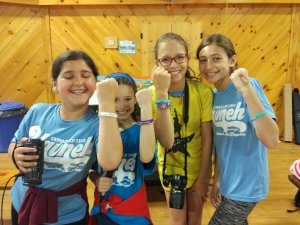
The ORT Start-Up Challenge program enabled hundreds of children at six Jewish summer camps across the US to explore Israel’s ‘Start-Up Nation’ through STEAM activities.

ORT professional instructors from World ORT Kadima Mada’s YOUniversity program ran two three-hour ‘mini hackathon’ sessions in each camp, encouraging inquisitive minds in an engaging, group-based format.

“ORT incorporated Israeli technological and start-up know-how, Jewish values and STEAM education,” said Moshe Leiba, Chief Informal Education Officer at World ORT Kadima Mada. “We brought these activities to Jewish summer camps throughout the US to show the importance of connecting the community to current world challenges and to engage the future generation in STEAM subjects and Tikkun Olam.”

The program encouraged collaborative and creative solutions using a contemporary challenge. Each camper was challenged to become a specialist in one of four fields: robotics, virtual reality, science, or photography and video editing.

Each group started by talking about creative thinking and problem solving.

This project-based learning experience provided a fantastic opportunity for the campers to try something new and to challenge themselves to gain the new skills needed to complete their task.

As with any successful start-up, each team required knowledge and skills from across all the expert groups to complete the challenge. And so, after the initial training in their chosen field, the campers formed start-up teams of the different skillsets.

“Virtual reality can show people what they’re thinking… they can draw diagrams and pictures… so the virtual reality can help give people a visual representation of a solution which could help people understand it.” – Gaby from Camp Nah-Jee-Wah, New Jersey.

The informal environment provided by a summer camp setting is an ideal forum for this program – it provides a chance to introduce young minds to new technologies and STEAM subjects in an engaging, group-based manner, enabling children to learn while having fun.

“They didn’t even realize how much they were learning,” explained Esther Staum Katz, Camp Director at Camp Shoshanim in Pennsylvania. “The solutions they came up with demonstrated creative thinking, problem solving, collaboration skills.”

Leading teams, such as “Shoresh Yarok” from Camp Yavneh in New Hampshire, decided on a multi-pronged campaign that would cover all areas of expertise. Their solution included a prototype of a robot to clear plastic in the ocean.

The group had some ambitious plans to research the development of a chemical, distributed by the robot, which could dissolve plastic. Their campaign included a virtual reality simulation to present a world overflowing with plastic to the UN, followed by a simulation illustrating their solution to the problem.

Finally, they would include a marketing campaign to educate people on the problem at hand, call for action and find sponsors to fund their great venture.

Michal Katz, Program Manager at Kadima Mada, said: “The campers were given a unique opportunity to take part in a meaningful learning experience through fun, hands-on activities.

“It was very exciting to see them think outside the box, collaborate with their teammates and enjoy themselves while coming up with impressive solutions to a very real and troubling ecological challenge.”

The ORT Start-Up Challenge was a great success. It created a significant impact with the campers and the camp directors and staff were grateful for the opportunity to bring such a unique experience to their camp with the help of ORT’s expertise.

If you are considering a project like this in your own school, think about how you can utilise all resources available to you to support learning. You would be surprised with how far students can go with project-based learning when given the right framework and tools to work with.

The US camps project developed out of Kadima Mada’s YOUniversity Centers of Excellence program, which provides extra-curricular STEAM learning to children living on the socio-economic periphery of Israel.

YOUniversity programs develop student interest in science and technology through enjoyable, practical courses, encouraging students with otherwise limited opportunities to engage with advanced subjects and improve their prospects.

‘It felt really good to know that I was able to help such an incredible organization’

See original article here

A Jewish day-school student has visited ORT projects in Israel after researching the organization’s work for her school tzedakah project.

Karen Glenn, a 12-year-old at Gideon Hausner Jewish Day School in Palo Alto, Calif., decided to research the work of ORT for the school project earlier this year. After contacting representatives for more information and inviting them to see her presentation, she was offered the chance to view the entity’s work while in Israel on a family vacation.

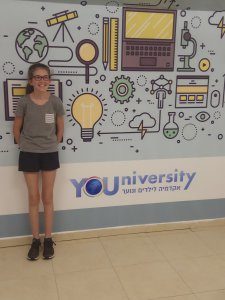
Karen visiting Kadima Mada projects in Israel

Karen and her family, including parents Orit and Jeffrey Glenn, traveled to the town of Kiryat Yam, near Haifa, to visit the Mada Park (Science Park) project, which features an oceanarium and planetarium.

A key feature of ORT’s work in Israel’s periphery is bridging the gap between aptitude and opportunity to ensure that Israelis from less privileged backgrounds have the same chances to succeed as those in the country’s more affluent center.

Following the visit, Karen said, “I was able to see firsthand some of the things ORT does, and it felt really good to know that I was able to help such an incredible organization.”

Rona Kwartez Roitman, development coordinator at Kadima Mada, World ORT’s Israeli arm, said “the Glenns showed so much interest and throughout the visit asked questions. I stressed to Karen how impressed we were with her and her research, and that we are delighted to see a young girl so interested in an organization with such a vast history.”

The trip was prompted by Karen’s school “Tzedakah Day” project. Kids give charity throughout the year, with older students assigned the task of learning about different charities and nonprofit organizations, making a presentation when it comes to the time to allocate their collected money.

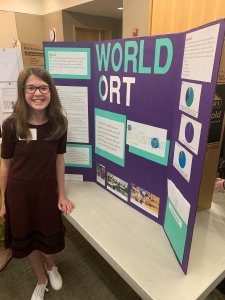
Karen with her school display boards

Karen decided to interview Harry Nadler, World ORT’s North American representative. After posing a series of follow-up questions to him by email after their initial Skype conversation, she produced charts and graphs to accompany her presentation at the school award day in late May, shortly before she celebrated her bat mitzvah.

Her display boards (in ORT-branded colors) included information about its mission, budget and work around the world; she also wrote an essay.

“I chose ORT because it has had a tremendous impact on education, especially in Israel, and because of its many years of experience,” she said. “The most interesting thing was when I realized how many projects and programs it has, and how incredible each one is.”

Matan Levi, an ORT graduate who resides in Northern California, attended the awards day at Karen’s school and met to discuss the project. “I saw her presenting her work with a lot of confidence, knowledge and passion,” he said. “I was blown away by Karen’s knowledge, maturity and ability to articulate complex topics at such a young age. She truly sees the importance to the world of ORT’s cause.”

Levi, who works as a product manager at a large technology firm in the Bay Area, said his own ORT education led him to an intelligence unit in the Israeli army, which opened a door to his “entire tech career.”