The World ORT LEAD Program: ‘Investing in our Future’

Before becoming Learning Development Manager for World ORT, I worked as Head of Key Stage at a Jewish secondary school, and as Deputy Headteacher at another Jewish school that caters for students with mild to moderate needs.

I have developed as a leader throughout my career. Despite this, I have had very little formal leadership training. My inspiration and on-the-job training came from observing leaders I admired as role models, incorporating colleague feedback as well as research from publications and blogs.

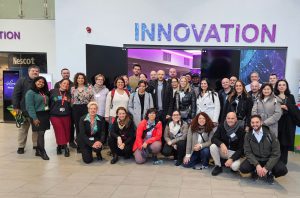
I was excited, therefore, to organize and observe this year’s LEAD Program, a four-day seminar facilitated by World ORT and leadership experts Christine Young and Graham Dring at Scuole della Comunità Ebraica in Milan. The 22 educators taking part travelled from 14 ORT schools across our international network to be involved.

The LEAD (Leadership in Education, Administration and Development) Program, which is supported by Dr. Louanne Smolin and David Eaton, along with the HH Wingate Foundation, aims to prepare the organization’s future educational leaders and senior managers by providing training in how to manage colleagues and to prioritize their own professional development journeys.  

It was inspiring to hear Graham and Christine’s flow of expert guidance, tips, and nuggets of wisdom. Leadership was described as a function of ‘knowing oneself’, with participants exploring emotional and spiritual intelligence, and being advised to ‘eat that frog’ – which is an approach advocating the immediate tackling of one’s most challenging tasks. Participants were continually challenged to share their opinions and experience in small groups, and to contribute their ideas and beliefs to the wider circle.
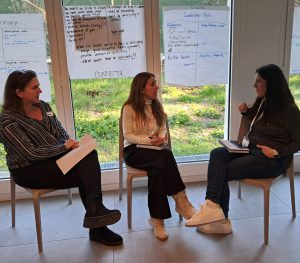
The LEAD course promotes coaching as a professional skill

School leaders are often teachers who have demonstrated outstanding practice. While they might not have any formal leadership training, they could be expected to suddenly demonstrate new skills and qualities, often in a position where they need to lead colleagues with whom they previously shared equal footing.

The seminar covered tools and concepts essential for any school leader. Participants learned about styles of leadership, and the benefits of utilizing different methods depending on context or personalities involved. They also completed a test in order to understand motivation profiles, and the need to implement different styles depending on the individual’s motivation ‘type’.

We discovered that individuals with a ‘spirit’ profile, for example, thrive on autonomy and empowerment. As leaders, our role is to understand what drives our colleagues and to adopt a style that enables them to perform to their highest potential.

We analyzed high-performing teams, looking at the stages of their development, and at how to grow and maintain trust within a team. I found the guidance on delegation especially insightful, particularly the importance of delegating directly to the individual who will be carrying out the task.
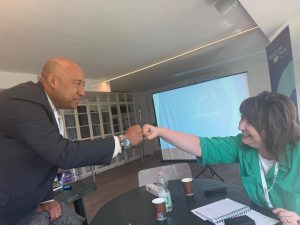
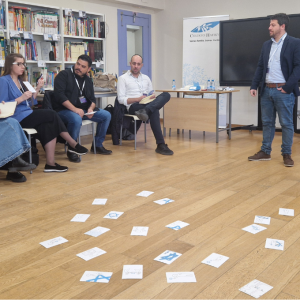
LEAD delegates work together to share knowledge and expertise

For me, the program highlight was witnessing the facilitated coaching sessions. Christine and Graham provided sharp insights into the how-tos of coaching, modelling the process at the beginning, and providing individualized feedback. I was truly jealous. Coaching is a valuable leadership tool, and the opportunity to learn and practice it in a risk-free environment is one I would have appreciated earlier in my career.

Delegates were excited by the new learning and approaches, and there was an appreciation of the relationships fostered, which will form the support network for an invigorated leadership journey.

Participants learned about each other’s settings and exchanged challenges, solutions, and ideas. It was inspiring to see professional connections and genuine friendships formed in such short a time, fueled by a joint vision and a renewed understanding of what it means to teach and lead in an ORT school.

The LEAD Program recognizes that the delegates are respected professionals and helps them to become even better. The benefit of them joining the program is felt by their students and the stakeholders of our schools.

Good leaders foster and retain motivated and talented teachers. This creates excellence in our schools, which is the best investment we can make towards our future.

Leor Harel is Learning Development Manager at World ORT
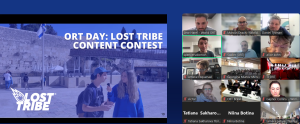
ORT Day 2025: Celebrating Our Network – and Jewish Pride

ORT Day, the annual global celebration of our network, took place with students participating from countries including Bulgaria, Lithuania, Mexico, Panama, Brazil, Georgia and Israel.

The event unites students, teachers, alumni and friends of ORT to celebrate our mission, which is to prepare people and communities all over the world for meaningful, self-sufficient futures.

Welcoming attendees to the online session, Daniel Tysman, World ORT’s Head of Education, said: “ORT Day is an annual event where we’re celebrating almost 150 years of education and training all over the world.

“This is an important celebration of being part of ORT but at the same time we are all very much aware that these are very difficult times to be part of the Jewish community, to be living in the Jewish world.”

The students heard from keynote speaker Spencer Solomon, Director of Marketing of Lost Tribe, an organization aiming to build a stronger Jewish future. He delivered a compelling talk about celebrating Jewish identity and Israeli culture in the digital space. It included advice on how to produce good content, the power of analytics in brand growth, working with content creators and influencers and concerns relating to posting online.

Spencer Solomon’s Lost Tribe session

Lost Tribe has 81,800 followers on Instagram and 123,400 followers on TikTok and Spencer told the session: “Lost Tribe is the largest online Jewish teen community in the world on social media. [It] leverages the power of new media platforms to cultivate Jewish life, spread knowledge and strengthen Israel-Diaspora bonds, making connections around the world to Israel and connecting and empowering the next generation to lead vibrant Jewish lives and overcome antisemitism with Jewish pride, identity, and joy.

“I think [Lost Tribe and ORT’s] missions are very closely aligned, so it’s awesome to be speaking with all of you today as I know you have a deep and profound understanding of the importance of a mission like this, which is really special.”

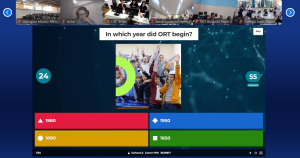
Following his talk, students tested their knowledge of the network at the annual ORT Day Quiz, for which they had previously received an information pack. The students answered questions about the foundation of the organization and its former and current programs. Liepa from ORT Sholom Aleichem Jewish Gymnasium in Lithuania won, collecting a $150 prize for herself and her school.

Students taking part in the ORT Day quiz

Jim Lodge, World ORT CEO, said: “I would like not only to congratulate you personally but to give applause to all of you. I am so impressed by both the depth on this program but also its international span, so it’s been a great pleasure being here. I want [to say] mazeltov to you all for what you are doing at our ORT schools, not only today, but daily throughout the world.”

All ORT network students were challenged to celebrate Jewish identity through social media: to create an engaging Instagram Reel or TikTok that is up to one minute long on any Jewish-related theme in their own style before April 16.

To enter, students need to follow and tag @ort.orglife on Instagram or TikTok, use the hashtag #ORTDay and send us a message with their full name and Instagram/TikTok handle. The best Reel or TikTok will win a special prize.

Ecology Summer School: Sloths, Snails and Scientific Studies

The opportunity to have breakfast while watching wild animals such as agoutis and coatis roaming free outside was one of the many attractions available to students participating in this year’s World ORT Ecology Summer School in Panama.

Twenty-seven ORT students aged 15 to 17 from nine of our Latin American and Spanish schools in Argentina, Brazil, Colombia, Spain, Mexico, Panama, Peru and Venezuela, along with ORT teachers Agustina Prola (Argentina) and Susan Siow (Spain), signed up for the two-week regional Spanish-language summer school in the Gamboa Rainforest in Soberania National Park.

The program gave the students, who are passionate about ecology, the opportunity to study different aspects of Panamanian biodiversity with experts from the Smithsonian Tropical Research Institute and Adopta Bosque, a non-profit NGO promoting rainforest conservation, conducting scientific ecological research.

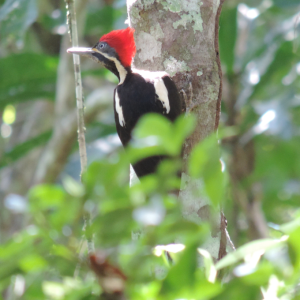
A woodpecker sighted in the rainforest

The students developed and refined research questions, hypotheses and work methodologies under the advice of the expert instructors Dr Chelina Batista, Ana Portugal Loayza and Ryan Oneil. They split into six groups for the research projects looking at reptiles, pollinators, bats, ants and the relationship between plants and animals in specific locations.

They accumulated measurements, drawings and photographs of the species under investigation and were able to view animals and plants they had not seen before, for example, Hoffmann’s two-toed sloth, the harpy eagle – the national bird of Panama – and different species of monkeys and birds.

They heard from experts Judy and Dr. Dan Dourson on tropical land snails and their roles in the tropical ecosystem and viewed samples with a magnifying camera. Josué Ortega, a mammal specialist from Panama, taught them additional skills for scientific field research, while sloth specialist Ryan Cano enthralled them with a talk on the genetic variability of the Panama Pygmy sloth.

Bird specialist Jorge Garzón talked about his research, while Macario Gonzalez spoke about the reptiles and amphibians of Panama and Adopta Bosque founder Guido Berguido gave a presentation about the conservation of rainforest biodiversity. The students also met the mayor of Panama City, Jewish entrepreneur Mayer Mizrachi, who encouraged them to excel in their scientific pursuits.

Rodrigo, a student from Brazil, said: “The [paleontological] excavation, breaking the rocks, was something I really wanted to do all my life. The trip to the cloud forest was stunning. My research project on ants, working with my team and the teachers who helped us – it was all really good.”

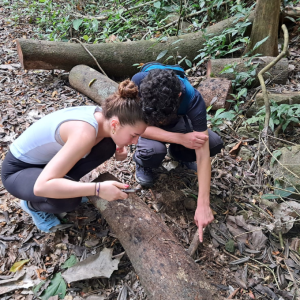
Students inspect a tree trunk

As important as the students’ scientific work was their forming of connections across cultures and borders. They bonded over the sharing of information about their own heritage and culture, including about music, sport and school life, and a trip highlight was the meaningful Shabbat ceremony officiated by World ORT’s Daniel Tysman and Gaynor Collins.

This was followed by a discussion led by Bernardo from Mexico about some teachings and dilemmas, which generated great interest among the students.

After a special dinner, Alona from Barcelona organized games for a joyful atmosphere.

Student Ezequiel from Panama said: “My highlight of the trip was Shabbat, sharing that special moment with each other. It was really well-planned.”

Daniel Tysman, Head of World ORT’s Education Department, said: “When the rainforest becomes their classroom, the learning becomes supercharged. In the evenings, our group gets to meet and interrogate some of the leading authorities on different aspects of ecology.

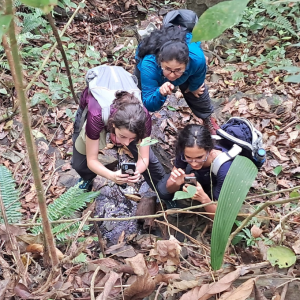
Some of the students hard at work

“It’s not unusual for teachers at the Summer School to stay up late to make sure students stop working on their projects and go to bed. The whole experience is really unique and in addition to the learning, in just a few days, memorable experiences were shared and many great friendships were made.”

After refining their work following feedback from teachers, the students took turns presenting their research projects, with each group delivering an excellent presentation, demonstrating great teamwork, confidence, and thorough preparation.

The trip also afforded the students the chance to see some of the sights of Panama, including the Oleoducto trail (the historic ‘Pipeline’ road that crosses the country, providing unparalleled access to the heart of the rainforest), where they saw diverse plants and animals, such as the woodpecker, the black-chested booby and the howler monkey. They dug for fossilised prehistoric sea creatures in excavated earth from the canal widening, met indigenous residents of the Embera village and visited the Summit Municipal Park, a botanical garden with facilities for the rescue and rehabilitation of exotic and native wildlife.

Elan, a student from Colombia, said: “Apart from all the fun and good moments I had with my new friends, I think the highlight was to push our limits, not only physical but also our knowledge. I had never written a scientific paper before, climbed a mountain to the cloud forest and dug for fossils, so I really felt pushed to my limits.”

‘This Seminar Deepened My Jewish Identity’

Dean Shannon, Jewish Education Teacher at Sir Manasseh Meyer International School, Singapore, reflects on his experience of the 2025 Jewish Educators’ Seminar

Despite being a Jewish educator for more than 10 years, I have rarely had professional development opportunities that tackled specific needs and ideas relevant to this world.

Facing our own challenges and ideals, the field of the Jewish educator can be a lonely one. This has been exacerbated in a post-October 7 world. I needed this Jewish Educators’ Seminar.

 I was a little sceptical about the seminar in advance. I questioned how suited I might be to an academic approach to Jewish education, but the seminar was filled with wisdom, depth, inspiration and even tears.

The speakers were excellent, the content was thought-provoking, and it was a privilege to share a room with all of the people involved. It was an incredible few days and the seminar exceeded all expectations.

 The ORT team who organized and led the seminar catered to our every need (and literally). The four-day program was outstanding. We covered an incredible range of topics and were exposed to a vast array of practical ideas that we can now implement in our classrooms.

One of the highlights was an exploration of classical Jewish sources on ecology. The session started with the leader hanging texts on a washing line. We were encouraged to look at the sources from ‘different angles’ and then choose the text with which we most identified. This then led into a chevrutah-style learning session and demonstrated the extent to which Judaism contains powerful wisdom to face 21st century challenges.

Damián Weber of Colegio Hatikva reflects on Jewish identity post-October 7

Further invaluable opportunities included a guided online tour of Sefaria and the National Library of Israel. These practical sessions provided insights in how to enable students to discover and utilise primary sources to enhance their Jewish identity. We even explored how to best use AI in the classroom to facilitate our teaching.

We were in tears and in deep contemplation during a post-October 7 activity that explored identity through artistic postcards. A session on the symbolism of food had us considering how powerful ‘culinary stories’ can be in connecting to our Jewish identity.

The walking tour of old Jewish Barcelona provided insights into the importance of ‘urban space’ in education and the Xueta Island movie screening demonstrated the depth, breadth and tragedy of Jewish history. Despite being a terrible artist, the most memorable and enjoyable session was one on Midrash and art.

I am now more confident in delivering a similar creative lesson to my capable students. Each session provided me with insights and ideas that will not only enhance my teaching practice, but has further deepened my own Jewish identity.

The other educators, who were involved in Jewish education and hailed from all over the world, were truly inspiring people, each with an incredible story. We shared, we debated, we laughed, and we cried.

Despite our different nationalities, backgrounds, and opinions, the common denominator was that we all believed in the importance of supporting Jewish education and giving Jewish people the ability to connect meaningfully to their heritage and identity.

I am grateful for all the incredible work ORT does. The Jewish Educators’ Seminar demonstrated how deep, profound, diverse, and beautiful is Judaism. The team made us feel like superheroes who are here to deliver our message to the next generation and to help make the world a better place. Am Yisrael Chai!

Let’s Talk Schools: AI is here to stay, let’s embrace it

This article first appeared in The Jewish Chronicle

JANUARY 19, 2025

It is a beneficial tool, which children should be taught to use responsibly

When ChatGPT burst on to the scene two years ago, some of my students, who had previously barely been able to string a few words together, were suddenly producing phenomenally well-constructed written work. They must have thought we, their teachers, were born yesterday.

The concern that students will lose the willingness or ability to study, and instead pass off work done by chatbots, is an extremely valid one. But Generative AI – of which ChatGPT is just one example – is also an immensely useful tool. In many schools, AI has become a focus for professional development as leaders seek to harness its potential while ensuring it is not misused.

World ORT is an educational not-for-profit that supports Jewish schools in more than 30 countries, prioritising high-quality STEM education. At our recent annual Hatter Technology Seminar, we explored how AI can enhance teaching and learning, support leadership and equip students for a future where mastering AI will be essential to succeed in the workplace.

We shared our fears about the risks posed by unregulated AI. There is an urgent need to adopt policies to promote responsible AI use and provide training that highlights its risks, including bias, misinformation and potential job losses. We must work towards ensuring that students develop their critical thinking in order to spot hallucinations, or inaccuracies, and to understand when to use their own thinking to complete tasks.

But we also learnt about the opportunities AI provides and that, as it rapidly evolves, we and our students must not be left behind. We were reminded that, just as previous technological advances – calculators in the classroom, for instance – caused concern, AI is also here to stay.

AI’s far-reaching benefits include improving student engagement and broadening access to learning in the classroom. Teachers can use AI to modify lesson plans, for example, to make them for accessible for pupils with special needs.

Crucially, we heard that creation is no longer the highest order of thinking in a post-AI world. To thrive, students must excel at collaboration and innovation, generating novel solutions and ideas. Our discussions emphasised the importance of training students to retain agency, use AI safely, protect privacy and spot bias and discrimination. The reinforcing of racial or gender stereotypes, among other inequalities, is also present in the virtual world – if you ask AI to create an image of a computer programmer, it will generate a visual of a young white male.

If we ban students from using AI, some will take advantage of it anyway; this will be at the expense of their engagement in learning. But by adapting our teaching and assessment practices to support responsible AI use, we can encourage openness, debate and collaboration. This creates an environment in which students develop critical thinking and ethical awareness. They will use AI for deeper learning and innovation rather than as a shortcut for rote tasks.

My priority at ORT is to create a forum in which participants can share resources and good practices and strengthen our professional networks. Our participants left motivated to serve as AI champions in their schools, leading professional development and training for both their teachers and students in responsible use of AI.

AI did not write this article but if it had and you had found it informative, would it matter? As educators, however, it is the process rather than the output that has always been at the heart of learning. Engaging with AI tools and using them to enhance students’ thinking – rather than doing the thinking for them – is critical.

Leor Harel is Learning Development Manager of World ORT

Students bridge 6,400km to collaborate on environmental project

High school students from Jewish schools in New York and Milan have taken part in ORT’s collaborative problem-solving pilot project aimed at inspiring young people to take action in tackling social and environmental challenges.

The grade 10 and 11 students from New York’s Yeshiva University High School for Girls (YUHSG) and the 11th grade students from ORT-affiliated Scuola Della Comunita Ebraica in Milan gained hands-on experience working in international teams, addressing real-world issues, and developing valuable transferable skills during the International Collaborative Problem-Solving Project.

Importantly, the pupils said they loved the three-month experience and that they had formed genuine friendships across borders during the project, which falls under World ORT’s Global Citizenship educational pillar. The project presented an opportunity for them to practice three Jewish values: achrayut (being accountable), achdut (unity), and chesed (kindness) through the development of their own social action projects.

The two teams worked together to explore social and environmental challenges shared by both communities; they decided to focus on environmental concerns. They then developed, with guidance, a project timeline, action and development plan to address the issue in each of their own communities.

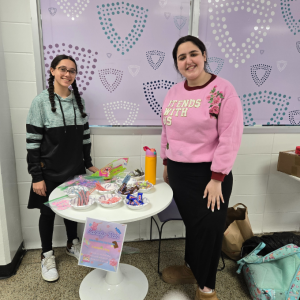
The team from YUHSG believed that community and education could stimulate environmental change for the positive, inspire awareness of the need to protect the planet and promote collective action for a “brighter, greener future”. They promoted the recycling of clothing, cans and bottles and took part in fundraising by making and selling treats to fellow students. They stressed the importance of a reduce and reuse mindset and helped in a clothing gemach (a loan store).

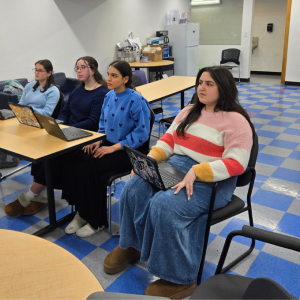
The team from YUHSG

Members of the YUHSG team

The team said: “Hashem gave us this world and we need to keep it clean and take care of it. By reusing and recycling waste we’re able to do that, and being given an opportunity to be a part of this project is amazing.”

Additionally, they said they aimed to create an environmental club to continue to raise awareness, present the project to peers and schedule a beach clean-up in the spring.

YUHSG team members fundraising

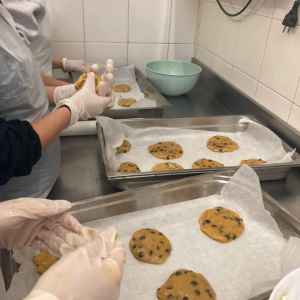
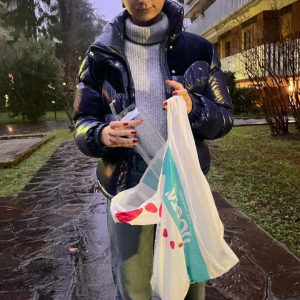
Meanwhile, the team from Milan (pictured above) gave themselves the moniker of The Eco Sisters and created a challenge for people to collect litter from their streets. As a reward, participants received an ecological jewel made out of recycled plastic, paid for through the sale of food they had made. They donated the remaining funds to an Italian organisation supporting environmental health and aim to continue the challenge and run jewellery-making workshops using plastic bottles.

The Eco Sisters make biscuits…

… and recruit litter-pickers

Joe Loeffler, who is a member of ORT America’s Board of Directors and is the lead sponsor of the project, said: “I’ve gone to visit a couple of ORT schools and they are truly amazing places and I hoped there would be a way to connect these amazing schools around the world to the Jewish day schools in the US.

“I want to express gratitude for connecting the Jewish community around the world because I believe that what you’re doing sows relationships that you might be able to enjoy for the rest of your lives.”

The teams shared that, alongside their more formal collaboration, they had also enjoyed being in touch with each other over WhatsApp and FaceTime in an informal way, speaking about their weekends and festival activities.

“That makes me so happy to hear … that you guys are building friendships because the Jewish world community is fragmented and you are solving that to bring Klal Yisrael together,” added Loeffler.

Daniel Tysman, Head of World ORT’s Education Department, said: “We’re giving these young people the tools for social action and empowering them to make positive change in their communities, and we’re also seeing them make connections and, in a few short weeks, transforming from complete strangers to friends. In these difficult times, it’s truly inspirational and heart-warming to see.”

ORT Seminar was a ‘Catalyst for Growth, Connection, Inspiration’

Educator Juan Carlos Porras from the Instituto Dr. Jaim Weizman, Costa Rica, reflects on his experience of a World ORT program in Mexico City.

Participating in World ORT’s Global Citizenship Education (GCE) seminar was an incredibly enriching experience that exceeded all my expectations. I arrived at the event full of anticipation, eager to dive into new ideas and connect with fellow educators passionate about promoting global citizenship.

Although I had previously been a mentor in the YEP program, this was my first time attending an in-person ORT event, and I was excited to engage directly with the ORT community.

From the very beginning I felt truly welcomed. Everyone from the organization greeted us warmly, making us feel like part of a close-knit family. The sense of unity was clear from our first dinner together, even before the official activities started. There was an immediate connection among participants, which created an atmosphere of collaboration and open-mindedness. Sharing stories and experiences during that initial meal set a positive tone for the days ahead, breaking down barriers and fostering new friendships.

The talks were deeply inspiring, filled with real examples of how GCE can be applied in everyday life. The speakers didn’t just share theories; they presented practical insights, success stories, and challenges, making the concepts relatable and actionable. Seeing the passion the guest speakers had for their projects was especially motivating.

The days were busy and energizing, packed with well-planned activities designed to make the most of our time. From morning sessions to evening reflections, every moment was used effectively. Despite the full schedule, the energy remained high, thanks to the excellent organization and the shared dedication of everyone involved.

Holding the seminar at Colegio Olamí ORT was a very meaningful experience. We got to see GCE in action – not just through the activities we were doing but also by observing how the school operates and prepares its students to be global citizens aware of the world around them.

Experiencing the school’s approach firsthand was eye-opening. We joined classroom activities, interacted with students, and saw innovative teaching methods that integrated GCE principles seamlessly. Building water filters with students in the Maker Space was a highlight – not just a hands-on project, but a real example of addressing global issues like water scarcity. Seeing the students’ enthusiasm and understanding of global challenges reinforced the impact of GCE on young minds.

All the activities were thoughtfully organized, balancing theoretical lectures with hands-on learning. On a personal level, the experience was profoundly moving and touched me deeply. The visit to the Casa Tochan Migration Center was especially impactful. Hearing personal stories from migrants gave us profound insights into global and local issues, highlighting the human side of topics often discussed in abstract terms. The tour of the Museum of Memory and Tolerance was both sobering and inspiring, emphasizing the importance of tolerance, human rights, and learning from history to build a better future.

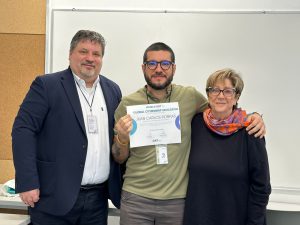
Juan Carlos at the end of the seminar with Daniel Tysman, Head of Education Department, and Amelie Esquenazi, World ORT Representative for Latin America

The group of participants was fantastic: educators from different backgrounds and countries, all united by a common goal. There was always a strong sense of camaraderie, and meaningful conversations could happen at any time – during sessions, meals, or informal gatherings. We shared professional experiences, personal stories, cultural perspectives, and educational philosophies. One of the most valuable takeaways is the network of contacts and friendships formed during the seminar. I feel that all the schools present truly left with the understanding that we are a global community that needs to work together.

We immersed ourselves in the vibrant culture of Mexico. Exploring Mexico City, enjoying its cuisine, and experiencing its rich history added an extra dimension to the seminar. We visited local landmarks, engaged with the community, and embraced the city’s energy, leaving us captivated by its beauty and spirit.

This experience not only strengthened my commitment to Global Citizenship Education but also had a profound effect on my personal and professional outlook. I return to my school with renewed enthusiasm, equipped with new strategies, resources, and a broader perspective on integrating GCE into our curriculum. The seminar reaffirmed the importance of fostering global awareness, empathy, and responsibility in our students. I’m excited to share these insights with my colleagues and to start collaborative projects with the new connections I’ve made.

In looking back, the seminar was more than an educational event; it was a catalyst for growth, connection, and inspiration. It reinforced the idea that education is a powerful tool for change and that as educators, we have the responsibility and privilege to shape the next generation of global citizens. I’m grateful for the opportunity to participate, and look forward to continuing the journey of promoting Global Citizenship Education in our schools and communities.

Juan Carlos Porras is a design teacher and integrator of technological education at the ORT-affiliated Instituto Dr. Jaim Weizman in Costa Rica

Hatter Technology Seminar Delegates Embrace Responsible Use of AI

The 17th annual World ORT Hatter Technology Seminar in London tackled a sometimes-controversial topic: Generative AI.

The 25 educators attending the four-day event, which focuses on STEM training, came from ORT schools and affiliates in Argentina, Brazil, Peru, Colombia, Panama, Mexico, Costa Rica, South Africa, Singapore, Israel, Czech Republic, Bulgaria, Lithuania, Estonia, France, Italy and Spain.

Welcoming the delegates, Lady Irene Hatter, whose late husband Sir Maurice – former World ORT President – established the annual event, said: “World ORT is committed to making sure that the education we provide is always up to date and relevant. This year, the subject of the seminar is Generative AI. This is a vital subject and, I believe, this is part of our future.”

The controversy surrounding Gen AI includes fears that machines will replace people, that the technology is not accurate and that students will cheat. Concerns over emerging technology, argued some presenters and delegates, are not new. Participants remembered fears over the introduction of the calculator in the classroom, for example.

Rather, they said, the technology is here to stay and already being used by students, therefore educators must embrace it for their own use – it can help them to reduce their workload by producing or refining lesson plans, for example – and design policies in their institutions to ensure students develop critical thinking skills to use it safely and improve their outcomes.

Daniel Tysman, Head of World ORT’s Education Department, said: “There’s no doubt that currently the biggest talking point for schools worldwide is AI. The Hatter Seminars allow ORT schools to connect with leaders at the forefront of STEM education, and this year’s event gave delegates a huge boost in understanding AI and the impact that it will have on their schools.

“From developing strategy and designing policies, enhancing teaching and learning, performing mundane tasks, delegates were given lots of ideas of how to approach each task and above all how they and their students can get the best use from this technology in an ethical and responsible way.”

The annual seminar provides an opportunity for ORT’s professional educators from around the world to explore the latest developments in teaching and learning in the areas of STEM and take them back to their institutions and maintain a network of educators for peer support.

After presentations from educational experts in the field of AI, delegates visited Yavneh College in Borehamwood, where Assistant Headteacher Brandon Pieters gave a talk on practical uses of AI for teachers.

Later, at North East Surrey College of Technology, CEO Julie Kapsalis expressed her excitement at the opportunity for collaboration between World ORT and the institution. Somayyeh Clifton, the college’s Head of Quality Improvement & Innovation and an expert on AI for Education and Training, discussed harnessing chatbots for practical support in AI-driven teaching and learning and highlighted tools and pedagogical approaches, including a deep dive into NotebookLM. She then introduced the college’s innovative VR Learning Resource Centre and delegates had an opportunity to try it for themselves.

One participant said the seminar had “changed the way I perceive AI”, adding: “It will make a difference to how I teach it in the future. The students will have the advantage of what I have learnt here.”

Roger Guerrero, Co-ordinator of Innovative Technology and Education at the ORT-affiliated Colegio Hatikva in Barcelona, Spain, said: “I came to the seminar because I wanted to share experiences with colleagues from around the world and see how they are implementing AI in their schools and how to lead the transformation in education. We learnt not just about the tools and how we can implement them, but also how to use and grade personalized programs for students with special needs.

“ORT provides us with a lot of educational programs and we can participate in them with students from around the world. My personal networking and my school networking is growing every day. I am very grateful and thankful to be here.”

World ORT’s Learning Development Manager, Leor Harel, said: “The Hatter Seminar was a fantastic opportunity to bring a diverse group of professionals together to network, share good practice and further our knowledge on a prevalent theme within education today.”

‘Outstanding’ Ariellah Rosenberg Receives 2024 Singer Award

Ariellah Rosenberg, CEO of ORT SA in Johannesburg, has been announced as the 2024 recipient of the Robert Singer Award for Outstanding ORT Professionals.

The annual award recognizes ORT professionals globally whose efforts and achievements, after years of service for the institutions in which they work, advance beneficiaries locally and support the global ORT network.

Ms. Rosenberg has dedicated her career to advancing education and skills development. She has helped shape ORT SA’s programs to bring STEM education, entrepreneurship and job skills to previously disadvantaged communities. Her role as CEO since 2013 has been pivotal in expanding ORT SA’s reach and impact, affecting thousands of youth, educators and businesses in the country.

She said: “This award is a tremendous honor and a reflection of ORT SA’s work to create meaningful educational opportunities. Over the past 20 years, I’ve seen the potential in every young person we work with and I remain inspired by their resilience and eagerness to learn.”

WATCH: Ariellah Rosenberg discusses her career and the 2024 Robert Singer Award

Robert Singer – former CEO and Chair of the Board of Trustees, World ORT; Former CEO, World Jewish Congress; Chairman, Center for Jewish Impact – for whom the award is named, described Ms. Rosenberg’s contributions to the field of education and to the ORT community as “outstanding”. He said she “exemplified the values we cherish” and added: “I can think of no one more deserving of this honor.”

He added: “Ariellah truly embodies the spirit of innovation and dedication that the Singer Award represents.

“Over her remarkable 20-year tenure at ORT South Africa she has consistently demonstrated an unwavering commitment to education, leadership and community engagement.

“Her ability to inspire and empower those around her has created a positive ripple effect, impacting countless lives and strengthening our organization.”

He said Ms. Rosenberg’s contributions extended beyond her role as a leader. “She is deeply involved in advancing educational programs and actively participates in World ORT’s networking initiatives, showcasing her passion for collaboration and growth. As a mentor, she nurtures the next generation of educators, fostering an environment of learning and development.”

Previously Head of Teacher Empowerment at ORT SA, Ms. Rosenberg has focused on creating programs that brought STEM education to hundreds of schools.

From establishing the organization’s Teacher Empowerment department and developing it into the STEM, IT, Skills and Enterprise Development Academies, to launching the Jewish First Lego League in South Africa, and ORT Coding Clubs reaching more than 6,000 learners, she has consistently worked on initiatives aimed at practical learning and skills development.

In each project, her goal has been to equip young people with knowledge and tools that can open doors for their future.

Throughout Ms. Rosenberg’s career, she has shared her insights at conferences and collaborated on educational initiatives globally. She has presented on youth development and the future of learning, gaining recognition for her focus on preparing communities for an evolving world.

She was also a finalist in ABSA’s Europcar Women in Leadership Award in 2020, the first South African to attend the Google Teacher Academy in London in 2010, a nominee for the Women of the Year Award in 2010 and has been interviewed on platforms such as CNBC Africa’s Innovate Africa show, where she discussed the concept of bridging the technology skills gap.

Ms. Rosenberg, who believes that with the right attitude and equal opportunities “the sky is the limit”, said being chosen for the award left her “speechless”.

“I have met Robert Singer and always admired his position and his work,” she said. “It is such a big honor and a privilege to receive this award – ORT is an amazing network of incredible people and work.

“I feel as if I’m standing next to giants and, being recognized, like I’m now a piece of that puzzle that’s called World ORT, not only locally, but part of this network that has benefited South Africa in so many ways. I had the privilege to really impact through education. I always say you can’t measure the impact because the impact grows as the children grow.

“ORT SA’s mission continues to guide me, and I’m grateful to be part of an organization committed to empowering communities and building brighter futures.”

Previous winners of the Robert Singer Award include Dr. Jorge Grünberg, Rector of the Universidad ORT Uruguay; Vladimir Kritsman, Principal of the Jewish school ORT “Pri Etz Haim” in Kyrgyzstan; and staff from ORT Ukraine.

Director General and CEO Update

Dan Green, World ORT Director General & CEO, has resigned from his position due to personal circumstances.

Dan has spent more than 12 years within the ORT family, first as CEO of ORT UK before becoming Chief Operating Officer of World ORT in 2016 and the Director General & CEO in 2020.

During his nearly five years as Director General & CEO, Dan oversaw World ORT’s global response to the Covid pandemic as well as directing our efforts to support our beneficiaries in Ukraine and Israel who have been so devastated by the wars in those regions.

Dan also oversaw the reconstruction of ORT House, a three-year project that saw us regenerate the building into a state-of-the-art new home for ORT.

Dan was also responsible for delivering World ORT’s new strategy and vision of the Three Pillars: Educating For Life, Jewish Experience and Global Citizenship which have breathed new life into our global network over the last four years.

Bob Grey, World ORT Chair, writes: “I would like to take this opportunity to personally thank Dan for his hard work, dedication and passion for ORT over the past twelve years, in particular in recent years when he has steered the organization through the challenges of Covid as well as the wars in Ukraine and Israel. On behalf of everyone at World ORT, I’d like to wish Dan every success for the future.”

Dr. Conrad Giles, immediate past President at World ORT, adds: “It was an inordinate pleasure working so closely with Dan during my tenure as President of World ORT. The relationship we shared together, between President and CEO, was a true partnership, and despite the incredibly challenging contexts we operated in, Covid, remote working and global conflicts, we always strove to move the organization forward and make life a little better for our beneficiaries. ORT will miss you, Dan!”

Simon Alberga, former Chairman of ORT UK and current Trustee and Officer of World ORT, said: “It has been a great pleasure working with Dan over the past 12 years, first at ORT UK and more recently at World ORT.

“Dan has been a loyal and passionate advocate for ORT throughout his time at the organization. He is a great communicator and a highly effective fundraiser, and I’ve enjoyed working alongside him in recent years raising funds from major donors and large charitable foundations on some of our largest projects. We will all miss Dan and wish him the very best for the future.”

Dan Green writes: “It has been an immense pleasure and privilege to work for ORT for the past 12 years. I have been able to witness first-hand the impact we have made across the globe by providing an education for life to hundreds of thousands of students whose lives have been immeasurably improved by ORT.

“I have been lucky enough to work with an incredible group of professionals in London and across the ORT Network who have inspired me every day. And I have also been fortunate to have been supported by a tireless group of volunteer leaders who have shared my passion for an incredible organization.”